Sulphur Springs/Hopkins County EDC Receives Texas Economic Development Council’s 2017 Community Economic Development Award
The Texas Economic Development Council announced the recipients of its annual Community Economic Development Awards for 2017. The awards were presented at a special awards luncheon at the TEDC’s Annual Conference in Houston. Sulphur Springs/Hopkins County EDC received the CEDA award for communities with a population of 10,001 to 20,000.
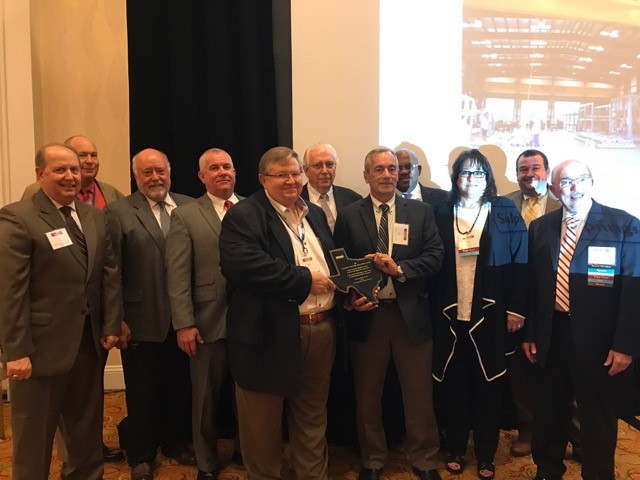
Sulphur Springs/Hopkins County Economic Development receives Texas Economic Development Council’s Community Economic Development Award. Pictured from Sulphur Springs: Tom Sellers, Clay Walker, Marc Maxwell, Roger Feagley, Mitsi Y’Barbo, and Craig Roberts. Representing Plant Processing Equipment are Ken Reynaud, Joe Borg, and Josh Burnett. Presenting the award for TEDC are Fred Welch and Ray Dunlap.
Sulphur Springs was in competition with Anna, Athens, Bay City, Brenham, Brownwood, Converse, Forney, Hildalgo, Katy, and Waller County. Nominees were judged on five criteria: innovativeness, transferability, community commitment and leverage, measured objectives, and secondary benefits. The CEDA program recognizes exceptional contributions of TEDC member cities toward the economic vitality of their communities and the state of Texas through creativity, leadership, and partnership in the achievement of business retention, business recruitment and community improvement.
Fred Welch, 2017 Chair of the Texas Economic Development Council, said, “Each community nominated achieved excellence in economic development and substantially improved the economic base of their respective regions. The recipient communities in each population category were recognized for extraordinary accomplishments in meeting the criteria set forth in the nomination process.”
Other award recipients in their categories include: Population less than 10,000-Cisco; Population 20,001 to 50,000-Greenville; Population 50,001 to 100,000-Conroe; Population 100,001 to 250,000-Wichita Falls/City of Burkburnett; and Population 250,001 and above-San Antonio.
The TEDC provides information, education and legislative services to its members to foster the expansion of existing businesses, the location of new firms and the development of strategies that promote a positive business climate in Texas. With more than 830 members, the TEDC is the largest state economic development association in the nation.
Early Voting Underway for Constitutional Amendment Election

Early voting in the November 7th Constitutional Amendment Election is underway at the Justice of the Peace Courtroom on Jefferson Street. The ballot contains seven (7) propositions. Early voting began Monday, October 23rd and continues through November 3rd. Currently, 31 early votes have been cast through end of day Tuesday.
Hours for early voting are 8 a.m. until 5 p.m. daily except Tuesday, October 31st and Thursday, November 2nd when early voting at the JP’s courtroom will be open 7 a.m. until 7 p.m. All 12 polling places in the county will be open November 7th, the day of the election, from 7 a.m. until 7 p.m.
Propositions being considered include:
- Proposition 1 Disabled Veterans/Property Taxes. The proposition would allow potential property tax exemptions for certain disabled veterans or their surviving spouses.
- Proposition 2 Home Equity Borrowing would ease restrictions on borrowing against home equity.
- Proposition 3 State Appointee’s Term would limit the term of unsalaried state appointees whose terms have ended but who have not yet been replaced.
- Proposition 4 Constitutional Challenges to State Laws would require Texas courts to notify the attorney general of any constitutional challenges to state laws.
- Proposition 5 Sports Team Charitable Raffles would allow more sports team charitable foundations to hold benefit raffles.
- Proposition 6 Deceased First Responders/Property Taxes would allow property tax exemptions to surviving spouses of first responders killed in the line of duty.
- Proposition 7 Financial Institutions/Promotional Raffles would allow banks, credit unions, and savings and loan institutions to conduct promotional raffles.

PJC Has Implemented Reforms Being Embraced Nationally

Many higher education initiatives touted at the recent American Association of Community Colleges annual meeting have already been implemented or are underway at Paris Junior College, according to three regents who attended the meeting.
Beginning with participation in Achieving the Dream over a decade ago to PJC’s current participation in the national Pathways Project, PJC has been using data to improve student success to allow them to reach their goals.
In the past year, PJC has been building on the work of HB 5 through the Pathways Project, assisting students to more quickly find their career paths and avoid taking unneeded classes. PJC has also hired a full-time dual credit coordinator to work more closely with high schools in the five-county PJC service area.
Regents Ginna Bowman, Caroline Lockett, and Charles Lynch attended the meeting and reported on what resonated most with them from the meeting. These included the need for college foundations to shift from funding scholarships to covering the cuts made to federal and state funding; develop a culture of inclusion and greater diversity as well as assistance beyond financial aid for students; the concept of helping those the College serves in understanding and embracing the rapid change of the digital age; and finding grant assistance to help PJC move forward.
“In this day and time, we’ve got to raise money to replace cuts from state and federal funding,” said PJC President Dr. Pam Anglin. “From 2012 to 2017, PJC revenue has gone from $40 million to $33 million due to cuts, while tuition charged to students has increased. “
“Our participation with Pathways, that culminates this week, has been funded by the Bill and Melinda Gates Foundation,” Anglin said. “Both the Gates and Lumina foundations work through the Texas Success Center to fund and improve student success through all 50 community colleges in the State of Texas. We participated in the Lumina-funded Achieving the Dream, so we have been very fortunate to participate in multiple situations through the last few years where the benefactors were the Gates and Lumina foundations.”
In other business, the Regents:
- Approved an additional hour added to the Electrician curriculum.
- Approved the merging of science lecture and lab courses in the Core Curriculum into one listing, with no change to the total semester credit hours.
- Discussed PJC representation on the Lamar County Appraisal District Board; PJC will follow-up with the District to express a desire for representation.
- Received a draft five-year workforce development plan for the College for review.
- Authorized Dr. Anglin to continue discussions with the bidder on the Recreation Center.
- Approved the employment of Student Financial Aid Assistant Director Kimberly Herron, Upward Bound Advisor Nichole Perry, and Emergency Medical Services Instructor Heath Thomas, and accepted the resignation of Educational Talent Search Advisor Katie Shipman.

Help-A-Child Chili, Brisket, Ag Mech Contest Winners at 2017 Benefit

2017 HELP A CHILD CHILI & BRISKET WINNERS AND PRIZE SPONSORS
1st Place Chili –INTERSTATE BODY SHOP
Sponsored by: INTERSTATE BODY SHOP
2nd Place Chili—SULPHUR SPRINGS PROFESSIONAL FIREFIGHTERS
Sponsored by: Association Local 3237
3rd Place Chili—SULPHUR BLUFF EASTERN STAR
Sponsored by: Sulphur Bluff Eastern Star
CHILI PRIZE SPONSORS:
INTERSTATE BODY SHOP
CNB of YANTIS
JAY HODGE CHEVROLET
1st Place Brisket—DEEP SOUTH
Sponsored by: Wade Bartley Auctions
2nd Place Brisket—Y-TOWN SMOKERS
Sponsored by: Peoples Communications
3rd Place Brisket—LEFTY’S CATERING
Sponsored by: Randy McCoy
BRISKET PRIZE SPONSORS:
STACEY’S FISH FRY
HOPKINS MASONIC LODGE
NORTEX TRACTOR
GRAND CHAMPION FFA MECHANICS PROJECT—COMO PICKTON FFA
ARTS & CRAFTS—COMO PICKTON FCCLA
Preliminary figures indicate a possible $55,000 to be disbursed to the 3 children’s charities we support–Texas Scottish Rite Hospital for Children, Northeast Texas Child Advocacy Center and Southern Christian Children’s Home.
Lady Cats Defeat Mt Pleasant to Assure at a Least Tie for District Lead

The Lady Cats’ volleyball team dominated their final regular season district game at home on senior night Tuesday (October 24) against Mount Pleasant, 3-0. The Lady Cats jumped out to an 8-1 lead in set one and never took their foot off the gas pedal winning, 25-8, 25-16 and 25-11. With the result of Texas High’s match with Greenville pending, the win by the Lady Cats assured that the worse they could be at the end of the night is tied for the district’s top record at 10-2.
The Lady Cats have now won ten straight district matches after opening district play 0-2. The Lady Cats are 27-12 for the season. If the Lady Cats end up tied with Texas High for first place, a match will be played to determine the district championship and the top seed in the playoffs. That match will more than likely take place at Mount Pleasant Friday at 6 p.m. right before the Wildcats and Mount Pleasant football game. Wildcats Volleyball Coach Justin Maness said the district’s number one seed would face Wylie East and the number two seed would play Forney. Bi-district games will be played next Monday or Tuesday.
In stats Tuesday night, Autumn Tanton led the team with 11 kills. Kaylee Jefferson had 10, Mieke VanBenthem had 9, Madi Vickery had 2 and Lexie Whisenhunt had 1 kill. Setter Anden Hammack had 31 assists. Hammack also led the team with 4 service aces. Tanton, Erika VanBenthem, Sadie Stroud and Whisenhunt had 1 service ace each. Libero Maggie McGlamery had a team high 13 digs. Jefferson had 5 and Hammack had 4 digs. Four players had one block solo: Tanton, Mieke VanBenthem, Jefferson and Vickery. Tanton had 2 block assists and Whisenhunt and Vickery had 1 each. Six senior were honored on senior night: N’sya Dugan, Anden Hammack, Kaylee Jefferson, Maggie McGlamery, Imani Taylor and Mieke VanBenthem.


Wildcat, Lady Cat Cross Country Wrap-up

The Wildcats’ cross country team was tenth and the Lady Cats seventeenth at the Region II-5A Championship Monday at Lynn Creek Park in Grand Prairie. The Wildcats top finisher, Landon Thornton, came closest to qualifying for the state meet. He finished 26th, ten spots behind the last qualifier.
Christian Palomino finished next for the Wildcats in 34th place. Eli Sellers was the third finisher for the Wildcats despite running most of the race after losing a shoe. Senior Peyton Vickery got off to a strong start but about half way through the race the torrid pace began to take effect and he was the Wildcats fourth finisher. Nabian Ramirez came in next for the Wildcats. All these Wildcats except Vickery will return next year.
For the Lady Cats, Sydney Washburn was the first finisher. Cross Country Coach Ross Hicks said Sydney ran well and gave it her all but said she too came up short attempting to qualify for the state meet. Other Lady Cats finishers behind Washburn were Katlyn Ferrill, Landri McKinney, Bailey Arrington and Samantha Vargas. Coach Hicks said the runners will admit that they did not perform their best. He added they all gave good effort but he said they need to be more focused. He praised the four seniors who ran their last high school cross country race: Peyton Vickery, Ed Ramirez, Hannah Dixon and Samantha Vargas.

Wildcat Coordinators Prepare for Friday Night in M Pleasant

Bye week and Mt Pleasant Tigers the topic of conversation for KSST Sports Director Don Julian and Wildcat football coordinators:
Wildcats Offense
Wildcats Offensive Coordinator Matt Young said the bye week was very productive for his offensive players. He said his guys had a tremendous week and brought a great attitude. Coach Young said he liked the improvement in the offensive line last week. The Wildcats play at Mt. Pleasant Friday night. Coach Young said the offense must respect the Tigers’ defense. He said the Tigers would be getting after it and would be excited about playing the Wildcats. Coach Young noted that Mt. Pleasant has won against the Wildcats the past two seasons. He said there was not anything overwhelming about the Tigers’ defense but he said they do a good job. Coach Young said Mt. Pleasant’s coaches do a good job of putting players in positions to make plays. He said the Tigers two defensive ends are long and can cover lots of ground. Coach Young said the Tigers are undersized inside but he added they know how to play at that size. He said the game is a must win for the Wildcats to keep their playoff hopes alive.
Wildcats Defense
Wildcats Defensive Coordinator Triston Abron said the bye week was a very productive one for the Wildcats. He said it allowed players to heal up some and to work on improving technique. That included spending time on tackling. Coach Abron said he did not think the Wildcats would be facing the district’s top rusher, Mt. Pleasant’s freshman running back Tylan Hines. He said it is his understanding that the back suffered a broken arm against Texas High last Friday. Coach Abron called the back impressive with his ability to see holes and hit them. It also leaves him wondering what scheme Mt. Pleasant might come up with to compensate for the loss. Coach Abron said the Tigers might turn to some other talented backs. He speculated they might move receiver Dorian Glinton back to running back. Last year Glinton had a big game rushing against the Wildcats. Coach Abron said he was also impressed with Tigers quarterback Josh Morris. He called him a big, thick lefty who does a good job of passing and of running the Tigers’ offense. Coach Abron also said the quarterback is a load when he runs with the football and he added he would try to run over defenders. Coach Abron said the Wildcats front seven would have to be active against the Tigers.

Fall Festival Chili Cookoff at Seniors Center Demonstrates Good Taste Among Chili Lovers

Fifteen entries of “Texas” chili were entered crock-pot style in the Senior Citizens Day Chili Classic for Fall Festival. Entries were judged, then served to local chili lovers at the Seniors’ Center at noon Tuesday October 24. The judges scored each sample of chili based on four criteria: color, aroma, consistency and taste. The points were added up and the winners proclaimed before the audience. Besides cash prizes, trophies and certificates, the winning cooks also gained bragging rights as the best chili makers in Hopkins County. Organizer of the fun and tasty celebration is Karon Weatherman, Director of the Sr’s Center.
1st Place – Michelle Mims and Judith Beck, Wesley House/Wesley Oaks
2nd Place- Craig Johnson with Edward Jones
3rd Place – Patsy Crist, 2017 Ms Hopkins County Senior and Ms Texas Senior Classic
Honorable Mention:
Audrey Greenway
Debbie Jones, Sulphur Springs Health and Rehab
Richelle Johnson, Centric Home Care
Vickie Pickle, Grocery Supply (No Photo)
Judges: Enola Gay Mathews, KSST Radio
Mike Patterson, Angels Home Care
Linda Mobley, At Home Healthcare
Charlotte Baxter, Carriage House Manor and Cottages
Bill Holden, B. T. Medical

1st Place – Michelle Mims and Judith Beck, Wesley House/Wesley Oaks

2nd Place- Craig Johnson with Edward Jones

3rd Place – Patsy Crist, 2017 Ms Hopkins County Senior and Ms Texas Senior Classic

Debbie Jones, Sulphur Springs Health and Rehab

Richelle Johnson, Centric Home Care

Audrey Greenway Vickie Pickle, Grocery Supply (No Photo)
Saltillo Lions, Miller Grove Hornets Qualify for State Cross Country Meet

The Saltillo Lions and Saltillo Lady Lions are both state bound after qualifying at the Class 1A Regional Race at Lynn Creek Park in Grand Prairie Monday. The Lions finished second as a team behind Miller Grove. Sulphur Bluff finished third as Hopkins County had a 1-2-3 finish. Walker McGill was the top Lions’ finisher in eighth place.
Other teammates headed for state are Trveor Moore, Hendrick Rios, Branson McGill, Lyle Bench, Dillon Beadle and Matthew Gurley. The Saltillo Lady Lions finished fourth in their regional race. Miller Grove finished first. The Lady Lions top finisher was Sienna Collins who finished second. Her state bound teammates include Jocelyn Ochoa, Kristina Wade, Madison Simmons, Danielle Ross, Ofelia Cabrera and Chandler Bain.
The state meets all take place on November 4 at Old Settlers Park in Round Rock.

Varsity Boys L to R: Hendrick Rios, Trevor Moore, Branson McGill, Matthew Gurley, Lyle Bench, Dillon Beadle & Walker McGill.