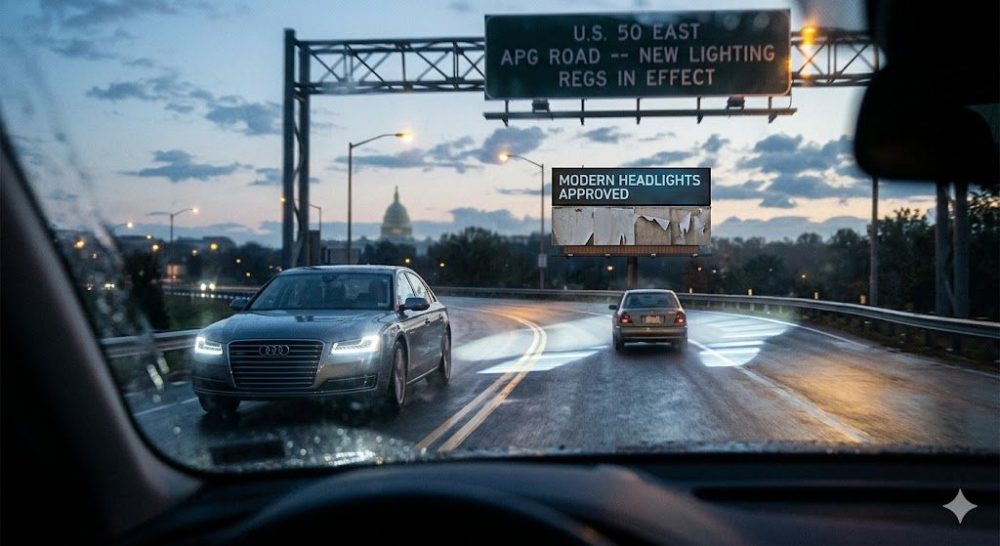
‘Matrix Headlights’ Now Legal in the USA
May 22, 2026 – WASHINGTON — For years, American drivers navigating dark, winding roads faced a frustrating, binary choice: blind oncoming traffic with high beams, or compromise their own vision with low beams. Meanwhile, drivers in Europe cruised under a blanket of daylight, courtesy of advanced “smart” headlights.
Now, the gap is finally closing.
Following a major, long-overdue update to federal vehicle safety regulations, the National Highway Traffic Safety Administration (NHTSA) has officially cleared the way for adaptive driving beam (ADB) headlights—commonly known as matrix headlights—on U.S. roads.
The policy shift amends Federal Motor Vehicle Safety Standard No. 108, an antiquated rule dating back to 1967 that required headlights to have separate, rigid high- and low-beam settings.
The Tech: How Matrix Headlights Work
Unlike standard headlights that use a single bulb or a static array, adaptive matrix systems treat the road like a digital projector screen.
- Precision LEDs: The headlights feature grids of dozens, sometimes hundreds, of individually controlled LEDs.
- Camera Integration: Onboard cameras constantly scan the road ahead for the taillights of preceding cars and the headlights of oncoming traffic.
- Dynamic Dimming: Instead of switching off the high beams entirely, the vehicle’s computer selectively turns off or dims only the specific LEDs pointed at other drivers.
The result is a constant high-beam field of view that illuminates pedestrians, wildlife, and road signs on the shoulders, while leaving other motorists in a perfectly cast pocket of shadow.
Background: Why Did It Take So Long?
The technology isn’t new. Audi, Mercedes-Benz, and BMW have been deploying matrix headlights in Europe and Asia for over a decade. However, the U.S. market was locked out due to a literal interpretation of a 1960s safety standard.
Because the law mandated that a headlight must be either a high beam or a low beam, the dynamic, constantly shifting nature of ADB tech was technically illegal. Even though many luxury cars imported to the U.S. over the last few years already had the physical matrix hardware installed, manufacturers had to programmatically lock the feature for American buyers.
Safety advocates, including the Insurance Institute for Highway Safety (IIHS), long lobbied for the change, pointing to studies that show a staggering percentage of fatal pedestrian crashes occur at night—crashes that could be mitigated by superior lighting.
What Happens Next?
Don’t expect every car on the lot to have this technology tomorrow. While luxury automakers can activate the feature via software updates on already-equipped vehicles, it will take time for the technology to trickle down to economy models. Furthermore, automakers must still test and certify that their systems comply with the rigorous, specific testing criteria outlined in the NHTSA’s new ruling.
Nevertheless, automotive experts view this as the most significant evolution in U.S. nighttime driving safety since the introduction of the halogen bulb. For American drivers, the future is looking a whole lot brighter.