Thousands of Educators Flagged In New Reporting System
May 22, 2026 – AUSTIN, Texas — A newly launched state transparency tool is shedding light on a troubling trend in Texas schools: thousands of educators and school employees are being flagged for criminal activity each year.
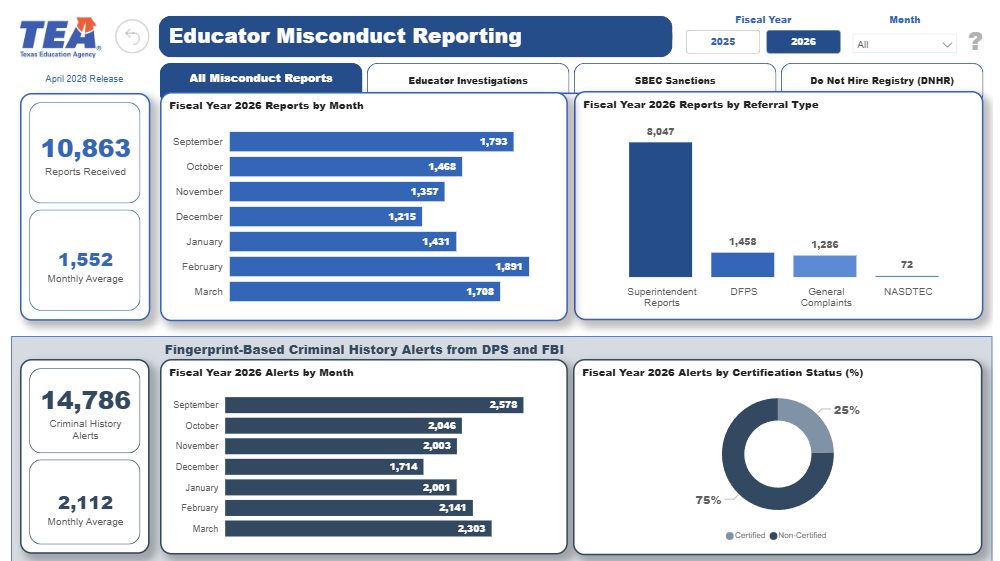
The Texas Education Agency (TEA) recently unveiled its Educator Misconduct Reporting Dashboard, offering the public an unprecedented look into reports of wrongdoing across the state’s education system. Early data from the dashboard is already raising serious concerns among lawmakers and education officials.
Between September 2025 and April 2026—the first eight months of the current fiscal year—the system recorded 17,060 criminal history alerts tied to school employees. These alerts stem from fingerprint-based background checks and updates provided by the Texas Department of Public Safety and the FBI. On average, more than 2,100 school workers per month were flagged for arrests or changes to their criminal records.
Notably, about three-quarters of those alerts involve non-certified employees, such as aides, support staff, and other personnel who work in school environments but are not licensed teachers.
At the same time, TEA’s Educator Investigations Division has significantly ramped up its workload. The agency is now opening an average of 1,158 investigations per month—more than double the monthly average from the previous year. Officials say the spike reflects both increased reporting and improved data tracking capabilities.
Among the most serious concerns are allegations of sexual misconduct. These cases—including inappropriate relationships between educators and students, as well as abuse involving minors—make up roughly 21 percent of all open investigations.
The dashboard’s release follows legislative action in 2025 aimed at increasing accountability in Texas schools. The measure, authored by Paul Bettencourt, was designed to centralize reporting and ensure that misconduct does not go unnoticed or unaddressed.
Bettencourt has been outspoken about the need for reform, arguing that a longstanding culture of silence in some school systems has allowed misconduct to persist. The new system, he says, is intended to expose problems and prompt faster action when allegations arise.
Background: Longstanding Gaps in Oversight
For years, critics have pointed to inconsistencies in how school districts report and handle employee misconduct. In some cases, educators accused of wrongdoing were allowed to quietly resign and seek employment elsewhere, a practice often referred to as “passing the trash.”
Prior to the new law, reporting relied heavily on local districts, and there was no centralized, real-time system for tracking criminal alerts tied to school personnel. The addition of automated fingerprint-based monitoring has changed that, allowing state officials to receive updates as soon as an employee is arrested or their criminal record changes.
What Comes Next
While the data does not necessarily mean all flagged individuals will face charges or lose their jobs, it does trigger review and, in many cases, formal investigations. State officials say the goal is not only to hold offenders accountable but also to prevent future harm by identifying risks earlier.
The dashboard is expected to continue evolving as more data is added and as policymakers assess whether additional safeguards are needed to protect students and restore trust in Texas classrooms.