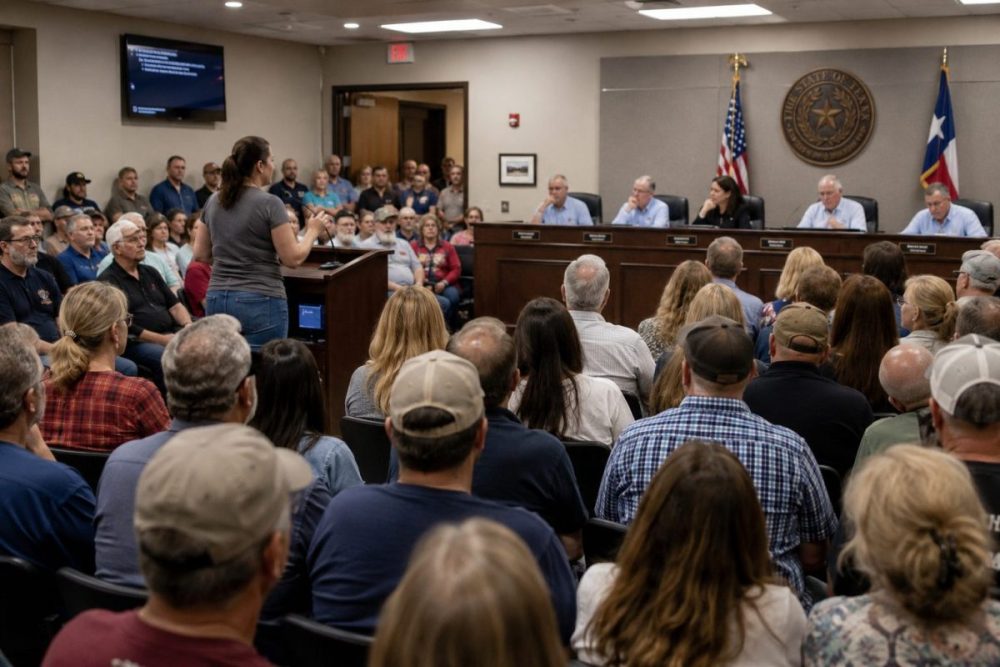
May 12, 2026 – ATHENS, Texas — After weeks of growing public concern, officials in Henderson County took a formal step Tuesday to address the rapid expansion of data center development across rural Texas. Following an extended public comment period that drew more than 200 attendees, county commissioners approved a resolution calling for stronger safeguards and greater state involvement in how and where large-scale data centers are built.
Dozens of residents spoke during the meeting, many voicing concerns about how these projects could reshape the character and resources of communities like Athens. Their concerns reflect a broader trend across Northeast Texas, where rural counties are increasingly being targeted by developers seeking land for energy-intensive data centers tied to artificial intelligence and cloud computing growth.
County Attorney Kenneth Strawn read the resolution into the record, emphasizing a balance between economic opportunity and resource protection.
“The Henderson County Commissioners Court supports responsible economic development, including appropriately designed and sited data center facilities,” Strawn said. However, the resolution formally opposes the use of open-loop evaporative cooling systems and other technologies that require large volumes of potable water in regions already facing water constraints. It also calls for enforceable safeguards to protect infrastructure, natural resources, and local residents.
Pct. 1 Commissioner Wendy Spivey underscored that the vote was not tied to any specific proposal.
“This is not a vote approving or denying any specific project today,” Spivey said. “It’s just a statement that economic development and protecting our community should go hand in hand.”
The debate in Henderson County mirrors a growing statewide issue. As demand for data processing power surges, developers have increasingly turned to rural parts of Texas, where land is more affordable and zoning restrictions are often limited. According to industry estimates, large data centers can consume millions of gallons of water per day for cooling and require massive, continuous electricity loads—placing strain on local utilities and the state’s already stressed power grid.
In Northeast Texas, residents and local leaders say those pressures are particularly concerning. Many rural counties lack the infrastructure to support such high-demand facilities, and officials worry about long-term impacts on groundwater, agriculture, and residential energy costs. Critics also argue that rural communities are sometimes approached with limited transparency, leaving residents feeling sidelined in decisions that could permanently alter their environment.
At the same time, proponents of data center development point to potential economic benefits, including job creation, increased tax revenue, and infrastructure investment. But in many cases, residents argue the trade-offs are not clearly defined, especially when compared to the scale of resource consumption.
The resolution passed by Henderson County commissioners calls on state lawmakers to take a more active role in regulating the industry, particularly in setting standards for water use, energy demand, and environmental protections. It also reflects a growing push among rural communities to gain more local authority over industrial-scale development.
As Texas continues to position itself as a hub for technology infrastructure, the outcome of debates like the one in Athens may help shape how—and where—that growth unfolds.