East Texas A&M University Partnered with The Sports Facilities Companies of Florida to Operate its new Sports Facility

August 8, 2025 – East Texas A&M University has partnered with The Sports Facilities Companies of Clearwater, Florida, to operate its new state-of-the-art sports facility, set to open in fall of 2026.
With over 90 managed venues and about 4,000 employees, SFC welcomes nearly 30 million guest visits and produces almost $1 billion in economic impact each year.
ET A&M President Dr. Mark Rudin says: “The Sports Facilities Companies’ expertise has been instrumental in turning our vision into a tangible reality, and we cannot wait to see the profound impact this state-of-the-art venue will have on our students, athletes, and supporters for years to come.”
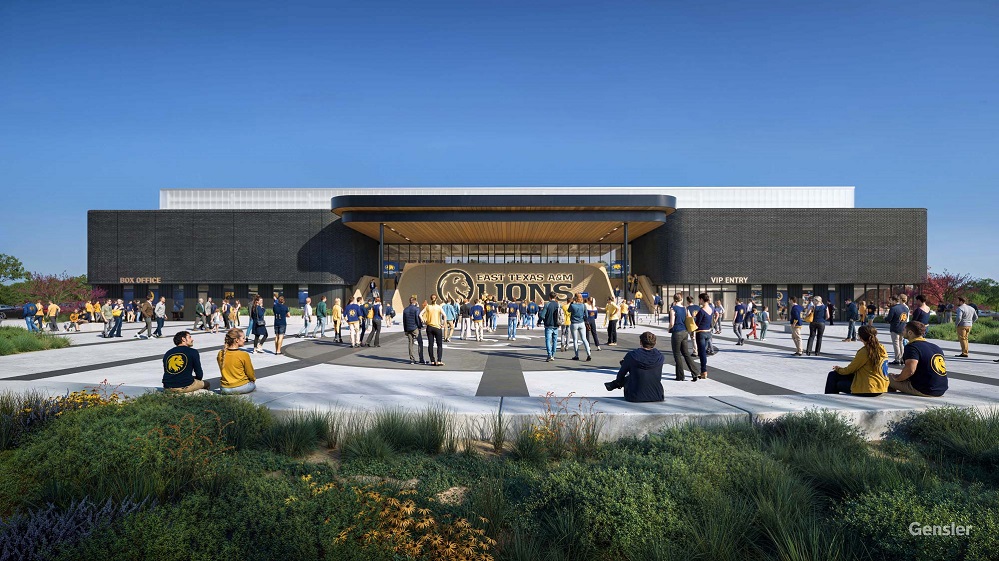
Construction on the 65,000-square-foot facility is already underway on State Highway 24 west of Whitley Hall, the University’s high-rise residence hall. An ET A&M news release says the impact of the Events Center will reach far beyond athletics. While athletics remains at the heart of the project, the facility will serve as a community hub. The versatile event center will enable ET A&M to host special events, trade shows, and other functions for the university and the Northeast Texas region. This dual-purpose approach broadens the facility’s value, making it a vital gathering place.
Key features of the new facility include:
Approximately 2,500 arena seats
Two suites
An arcade and other family entertainment amenities
An adjacent hotel
State-of-the-art event space, capable of hosting community events, concerts, trade shows, and more
One of East Texas A&M University’s Most Iconic Buildings is Coming full Circle – Binnion Hall
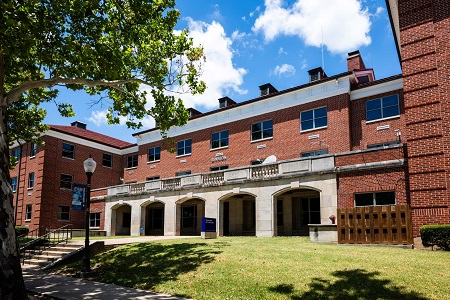
August 8, 2025 – After decades of academic use, one of East Texas A&M University’s most iconic buildings is coming full circle. Binnion Hall … on the east side of campus adjacent to Monroe Street … is set to undergo a transformative renovation that will return it to its original purpose: student housing.
Scheduled to begin next year, the project will breathe new life into the three-story building, quoting a university news release, blending historic charm with modern comfort.
Once complete, Binnion will house up to 200 students in a reimagined space designed specifically for sophomore, junior and senior-level students. The University says the renovation marks a bold step in preserving the past while investing in the future.
The estimated cost of the project is around $24.8 million. $4.3 million in cash reserves have been allocated to cover design and pre-construction costs. For the remainder, the university plans to utilize a $20.5 million revenue bond. The Texas A&M University System, acting on behalf of East Texas A&M, will issue this bond.
Contracts will be awarded in Fall 2025, Construction is expected to begin in late 2026 or early 2027, with a projected completion date in 2028.
When complete, student housing at Binnion Hall will offer suites, with bathroom and shower facilities included within the suites addressing a top student preference, moving away from traditional communal bathrooms, and Community-Focused Spaces, including a lounge, a business center, a gaming center and laundry facilities. Additionally, a dining room will connect to a commercial kitchen. On the upper level, study areas and student lounges will provide convenient spaces for individual or group study.
Fans of Colleen Hoover’s Novels can Look Forward to More Movies Based on her Books

August 8, 2025 – Fans of Colleen Hoover’s novels can look forward to three more movies based on her books.
On her Facebook page, Hoover, the best-selling author from Sulphur Springs and Saltillo, has announced that filming has been completed on movies based on her books, “Regretting You,” “Reminders of Him,” and “Verity.”
“Regretting You” will has a release date of Oct. 24 this year. “Reminders of Him” will be released on Feb. 6, 2026, while “Verity” will come out on Oct. 2, 2026.
“Regretting You” stars Mckenna Grace, Mason Thames, Allison Williams, Dave Franco, Scott Eastwood and Willa Fitzgerald. A trailer of “Regretting You” can be seen on Colleen’s Facebook page.
“Reminders of Him” stars Maika Monroe, Tyriq Withers, Rudy Pankow, Lauren Graham and Bradley Whitford as well as country music singer Lainey Wilson, who’s acting in her first film.
“Verity” will star Oscar-winning actress Anne Hathaway, Josh Hartnett and Dakota Johnson.
Last summer, a movie production of Hoover’s 2016 novel “It Ends With Us” starring Blake Lively and Justin Baldoni in the lead roles, became a huge hit. Variety said that the film brought in $349 million globally.

Texas Supreme Court Lawsuits and Looming Special Sessions

August 8, 2025 – A legal and political showdown is intensifying in Texas as Attorney General Ken Paxton files a lawsuit with the Texas Supreme Court asking the court to declare the seats of 13 Democratic House members vacant. These lawmakers fled the state to block a GOP‑led redistricting vote, effectively shattering quorum during the current special session. Paxton argues their public refusal to return constitutes abandonment of their duties. If the court agrees, Governor Greg Abbott would be empowered to call special elections to fill those seats.
The Texas Constitution requires 100 of the 150 members, or two-thirds, to be present in order to conduct business. On Friday, only 95 were in attendance.
This lawsuit comes on the heels of an earlier, nearly identical legal action by Governor Greg Abbott, targeting Democratic Caucus Chair Gene Wu. Abbott also urged the Supreme Court to expel him, claiming quorum-breaking equates to abandoning his office. Legal experts, however, note that historically, only the legislature itself can discipline members—via a two-thirds vote—making such judicial removal unprecedented and constitutionally dubious.
It appears that the record for the most special sessions was set in 1919. Set by Gov William P. Hobby at an astounding 11.
While Republicans continue to ramp up pressure—with civil arrest warrants, daily fines, and calls for enforcement across state lines—Democrats remain defiant. They argue their walkout is a legitimate, constitutionally protected form of legislative dissent and accuse Republican leaders of weaponizing the courts to force political outcomes.
Meanwhile, Governor Abbott has signaled readiness to call additional special legislative sessions, pushing to pass redistricting with or without returning Democrats. Analysts deem another special session “probable” should the standoff continue unresolved by the court.
Weekend Weather Outlook: Hopkins County, Texas — August 9–10, 2025

August 8, 2025 – Hopkins County, TX — Residents of Hopkins County can expect a classic Texas summer weekend, with hot temperatures, plenty of sunshine, and a slight chance of afternoon thunderstorms.
Saturday, August 9:
The day will start off mostly sunny with temperatures quickly rising into the low 90s by mid-morning. Afternoon highs are expected to peak around 96°F, with heat index values nearing 105°F. Winds will be light and variable. There’s a 5% chance of isolated thunderstorms in the late afternoon to early evening, typical of summer convection in the region. Locals are advised to stay hydrated and limit strenuous outdoor activities during peak heat hours (1–5 p.m.).
Sunday, August 10:
Conditions remain similar on Sunday, with mostly sunny skies and a high around 97°F. Humidity levels will remain elevated, keeping the “feels like” temperature above 100°F for most of the day. The chance of rain slightly increases to 30%, especially in the early evening hours. Overnight lows will remain warm, dropping only to the upper 70s.
Safety Reminder:
With elevated heat indices expected, the National Weather Service may issue heat advisories. Residents are urged to check on vulnerable neighbors, stay in air-conditioned environments when possible, and never leave pets or children in parked vehicles.

COMMISSIONER SID MILLER LAUNCHES POWERFUL TOOL AGAINST NEW WORLD SCREWWORM
August 8, 2025 – AUSTIN – The Texas Department of Agriculture (TDA) continues to lead the fight against the threat of the New World Screwworm (NWS) by developing a state-of-the-art attractant to be used in tracking screwworm fly movement and proactively eliminating them where they are located.
“When it comes to safeguarding Texas’ $15 billion cattle industry, we need to focus on action rather than words. That’s why I instructed my Biosecurity team to develop an effective screwworm lure,” said Texas Agriculture Commissioner Sid Miller. “This new attractant, named TDA Swormlure, marks a serious upgrade in our efforts to protect Texas livestock from the threat of the New World Screwworm (NWS), now roughly 370 miles south of Texas,” Commissioner Miller added.
Miller said that other tools like the Sterile Insect Technique (SIT), which was used in fighting against the screwworm threat from the 1930s to the 1970s, will still play an important role, but it’s no longer enough. Miller said that relying only on sterile flies is outdated and that new and improved approaches are required. He said TDA Swormlure marks a new chapter in prevention, supported by science, intended for widespread use, and created with smarter tools and a stronger defense.
TDA Swormlure features a sophisticated chemical blend that is enclosed in a proprietary polymer and has an easy-to-use delivery system. It is currently being tested in Panama, a screwworm hot zone, through a partnership with the United States Department of Agriculture’s (USDA) Animal and Plant Health Inspection Service (APHIS). Commissioner Miller said early feedback has been encouraging, and the traps are expected to outperform anything else available.
Commissioner Miller said that the Texas Department of Agriculture is not stopping with just TDA Swormlure. “We’re collaborating with the USDA, the US Food and Drug Administration (FDA), and industry leaders to develop a comprehensive set of tools to directly combat the screwworm,” Miller added.
These tools include:
- A TDA Swormlure fly trap that will kill up to 90% of flies on contact.
- A new Ivermectin feed additive for livestock and deer populations.
- A cattle vaccine, currently in development, that kills screwworm larvae.
Miller said that the TDA is leading the way because we understand what’s at stake. “Texas ranchers deserve better than outdated practices and bureaucratic complacency. We’re taking real action with effective solutions to stop NWS in its tracks. This is Texas innovation in action, and it’s exactly what our agricultural industry needs.”
SB 11 Allows Texas Public Schools to Set Time For Prayer

August 7, 2025 – Effective September 1, Senate Bill 11 permits Texas public schools to adopt policies allowing a voluntary daily period of prayer and religious reading for both students and school employees. Under this new law, districts can designate a set time during the school day for individuals to engage in silent or spoken prayer, Bible reading, or the reading of other religious texts, as long as participation remains entirely voluntary.
Supporters of the legislation argue that it protects religious freedom and provides an opportunity for spiritual reflection during the school day. They emphasize that the bill is designed to respect individual beliefs without imposing any particular faith on students or staff.
Schools that choose to implement the policy must make it clear that participation is not mandatory and that students cannot be pressured or coerced into taking part. The law aims to balance religious expression with constitutional safeguards, ensuring that no student is excluded or singled out based on their participation or beliefs.
Opponents of the bill have expressed concerns about the potential for peer pressure or unequal treatment of students from minority or non-religious backgrounds. However, state leaders argue that the voluntary nature of the policy addresses those issues.
The State Fair of Texas Announces 2025 Big Tex Choice Awards Finalists

By Veronica Delgado | August 6, 2025 | It’s fry-nal countdown time for some of the most iconic food titles in all of Texas. The State Fair of Texas is proud to present the finalists for the 21st Annual Big Tex® Choice Awards presented by Karbach Brewing Company. For the first time ever, the Big Tex® Choice Awards is raisin’ a glass to a brand-new category—one that recognizes the wildest, most delicious drinks at the Fair.
Winners for the Big Tex Choice Awards will be crowned on Thursday, August 21, in the categories of “Best Taste – Savory,” “Best Taste – Sweet,” “Best Taste – Sipper,” and “Most Creative.”
Back in June, a record-breaking 76 entries represented by 50 concessionaires were narrowed down to 30 semi-finalists, with each entry having been evaluated on four Fair-food elements: uniqueness, creativity, presentation, and taste. After testing all the tasty dishes, votes were cast, and the results are in. Fifteen finalists must now bring it on before a prestigious panel of celebrity judges in hopes of taking home one of the top prizes at the Most Texan Place on Earth®. Don’t worry – even if a semifinalist didn’t make the final cut, you’re not missing out—all semifinalist creations will be available at the Fair this year.
Without further ado, the State Fair of Texas is happy to present the 15 finalists who will compete for the coveted titles of “Best Taste – Savory,” “Best Taste – Sweet,” “Best Taste – Sipper,” and “Most Creative” in the 2025 Big Tex Choice Awards competition.
SAVORY
Brisket & Brew Stuffed Pretzels, Glen & Sherri Kusak
Brisket & Brew Stuffed Pretzels are where smoky BBQ dreams meet classic pub snacks in one golden, salty twist. We’re talking tender, slow-smoked brisket loaded with deep, juicy flavor, and blended with a bold, velvety beer cheese made from sharp cheddar and a hearty brew. Then, it’s all wrapped up in soft, chewy pretzel dough, hand-rolled, sprinkled with sea salt, and baked to crispy, crave-worthy perfection. Each bite is a flavor bomb: salty on the outside, rich and gooey on the inside. They’re easy to carry and absolutely made for munching as you wander the fairgrounds. Pair with a cold German beer or dunk into spicy mustard or tangy BBQ sauce—just be warned, your lederhosen might not forgive you.
Crab & Mozzarella Arancini, Stefan T. Nedwetzky
Our Crab & Mozzarella Arancini are handcrafted with an irresistible blend of premium Maryland Blue Crab meat, white rice, mozzarella cheese, spring onion, red bell pepper, lemon, and black pepper. Each rice ball is delicately seasoned with aromatic herbs including garlic, coriander, and basil. They are dipped in a crunchy breadcrumb coating, then deep fried to a golden, crispy finish. Handmade in small batches to ensure the highest quality! Served with a side of our homemade marinara sauce.
Deep Fried Deli Tacos, Brent & Juan Reaves
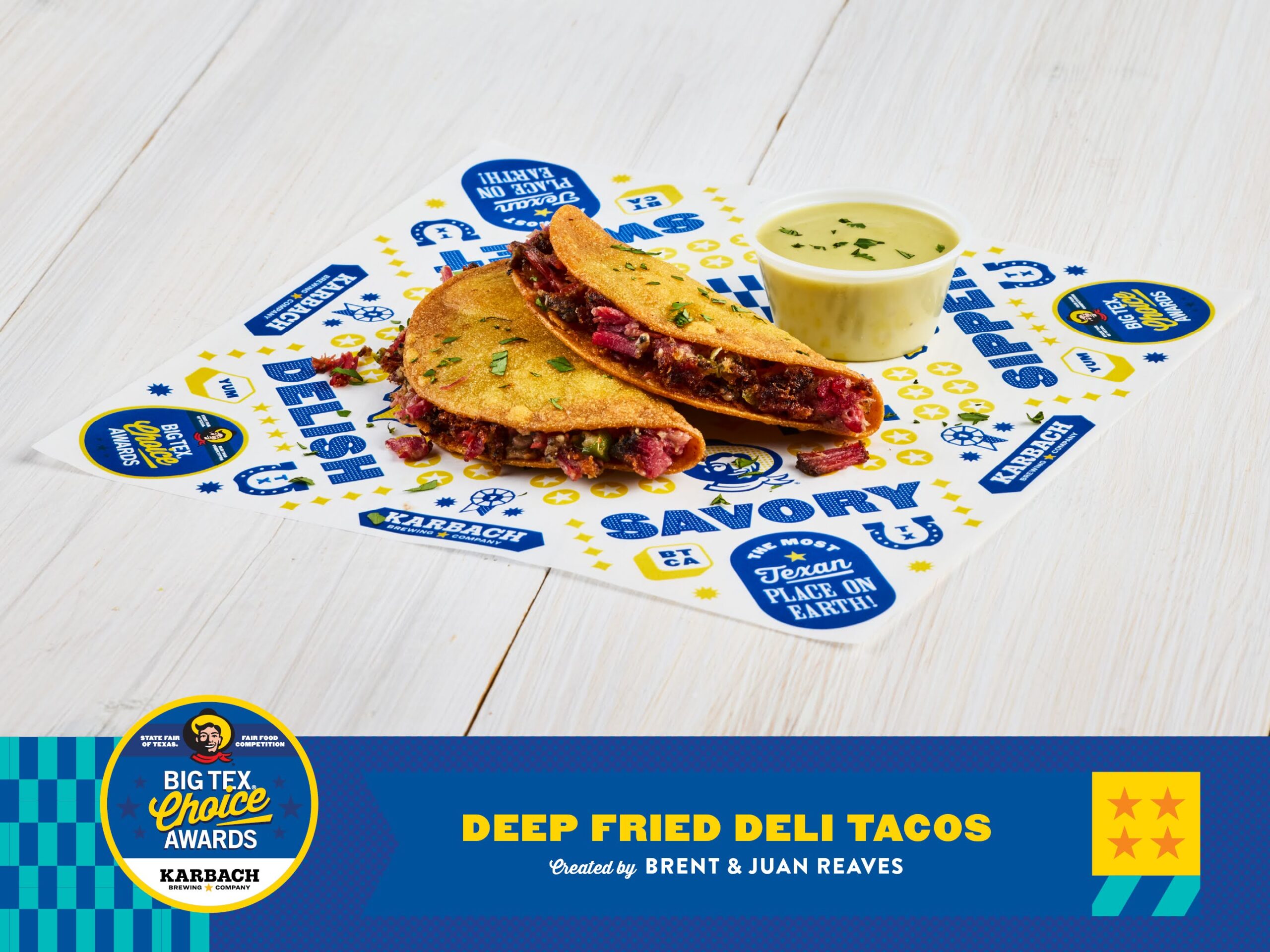
We all love a good food mashup, and the Deep Fried Deli Tacos are fusion magic at the State Fair of Texas. Picture this: peppery pastrami, buttery mashed potatoes, gooey white cheese, and fresh chives all tucked into a corn tortilla and deep fried to crispy perfection. Served with a spicy, creamy green sauce, it’s what happens when New York deli meets Dallas taqueria—and the result is delicioso.
Vietnamese Crunch Dog, The Le Family
Step right up for a bold twist on a fair favorite! The Vietnamese Crunch Dog blends the classic corn dog with vibrant Asian flavors. Juicy, marinated meat is wrapped in fluffy batter, coated in a crispy mix of panko and bánh mì crumbs, then deep fried to golden perfection. Topped with sriracha mayo and served with tangy pickled veggies, it’s a crunchy, flavorful mashup of street food and fair flair in every bite.
Wagyu Bacon Cheeseburger Deviled Egg Sliders, Kendall Williams
Who knew a deviled egg could become the juiciest, most flavor-packed burger slider ever? We did! The Wagyu Bacon Cheeseburger Deviled Egg Sliders start with a Cajun-seasoned Wagyu patty, topped with aged cheddar and crispy applewood bacon. The twist? Instead of a bun, it’s sandwiched between two deep fried, panko-crusted deviled egg halves—crispy outside, creamy and tangy inside. Served with a house-made ketchup-inspired sauce, it’s a bold, one-of-a-kind bite you have to try at this year’s Fair!
SWEET
Candy Lemon Sour Face, Chef Heather J. Perkins
Take a bite out of a candy-dipped lemon! With a little bit of sweet and a little bit of sour, let your taste buds explore the explosion of a sour, sweet tart-taste of a delicious, candy-coated lemon. Indulge in Candy Lemon Sour Face and let us take you on a rollercoaster of sweet and sour flavors!
Chill & Thrill Delight, Tony & Terry Bednar
Chill & Thrill Delight is a vibrant, refreshing twist on Colombia’s famous Salpicon de Frutas that is perfect for a warm day at the State Fair. A Texas-sized cup is packed with juicy, diced mango, pineapple, watermelon, grapes, cantaloupe, and strawberries, all soaked in fresh watermelon juice with a splash of lime. It’s topped with a handcrafted shaved mango sorbet that slowly melts into the mix for a sweet, tangy fusion. Whether you’re cooling off or chasing bold flavors, this fruity treat is sure to thrill!
Dubai Chocolate Cheesecake, Stephen El Gidi
Dive into a decadent cup layered with pure indulgence. At the base, rich Belgian chocolate melts into a luscious pistachio spread, perfectly blended with the delicate crunch of sweet, golden kataifi and a hint of creamy tahini. Nestled above are chunks of velvety New York-style cheesecake, adding a smooth and tangy contrast. To finish, each cup is crowned with a generous drizzle of silky chocolate, a swirl of pistachio cream, and a final sprinkle of crushed pistachios for an irresistible crunch. Every spoonful of Dubai Chocolate Cheesecake is a masterpiece of texture and flavor—nutty, creamy, and decadently chocolatey.
Rousso’s Dubai Chocolate Funnel Cake Fries, Isaac & Joey Rousso
Rousso’s Dubai Chocolate Funnel Cake Fries bring bold, indulgent flavor to every bite! Crispy, golden funnel cake strips are drizzled with warm Belgian chocolate, then topped with pistachio cream and delicate pieces of knafeh pastry. This rich, nutty, and crispy treat takes funnel cake to a whole new level of indulgence—sweet, airy, and wildly satisfying.
Tex’s Toast á la Mode, Michelle & Jayse Edwards
Tex’s Toast á la Mode is comfort food at its finest! A warm, golden-baked French toast bake topped with a generous scoop of Blue Bell® Homemade Vanilla Ice Cream slowly melting into every cozy bite. Drizzled with rich caramel and real maple syrup, then sprinkled with a fun cinnamon cereal crunch for that extra pop. It’s like a sweet, Southern hug on a plate that’ll have you coming back for more.
SIPPER
Coconut Quadruple, Binh Tran & My Vo
Want a taste of the tropics during your visit to the State Fair of Texas? Look no further than the Coconut Quadruple! A whole fresh, young coconut is served with an ice-cold, fresh-made coconut slushy topped with soft-serve coconut ice cream and a sprinkling of coconut flakes. This enhanced island delicacy is sure to transport you to paradise at first sip.
Cookie Chaos Milkshake, Brad Weiss
This shake is what cookie dreams are made of! A rich, creamy, cookie butter milkshake loaded with snickerdoodle chunks, Golden Oreo® Cookies, and classic Oreo® Cookies for the ultimate cookie explosion. We top it with a fluffy swirl of whipped cream, a scoop of edible cookie butter cookie dough, a perfectly perched Biscoff® cookie, and a cookie butter drizzle that ties it all together. Finished with a rim coated in crushed Biscoff ® cookie pieces for that extra crunch in every sip, the Cookie Chaos Milkshake is sweet, spiced, and unapologetically over the top.
Hot Honeycomb Lemonade Shake Up, Tom Grace
Ever tried nature’s candy—honeycomb? How about honey jalapeño lemonade? For over 30 years, our fresh Lemonade Shake Up has been a Fair favorite: fresh-squeezed lemons, sugar, water, and a good shake. This year, we are adding honey and fresh jalapeños to the mix for a perfect Texas kick. Rimmed with chamoy and Tajin® for extra zing, and topped with a skewer of real honeycomb, our Hot Honeycomb Lemonade Shake Up is a refreshingly bold treat. Add a shot of alcohol, and you’ve got an instant classic—only at the State Fair of Texas!
Nevins Dirty Red Bull® Tex-arita, Josey Nevins Mayes & Tami Jo Nevins Mayes
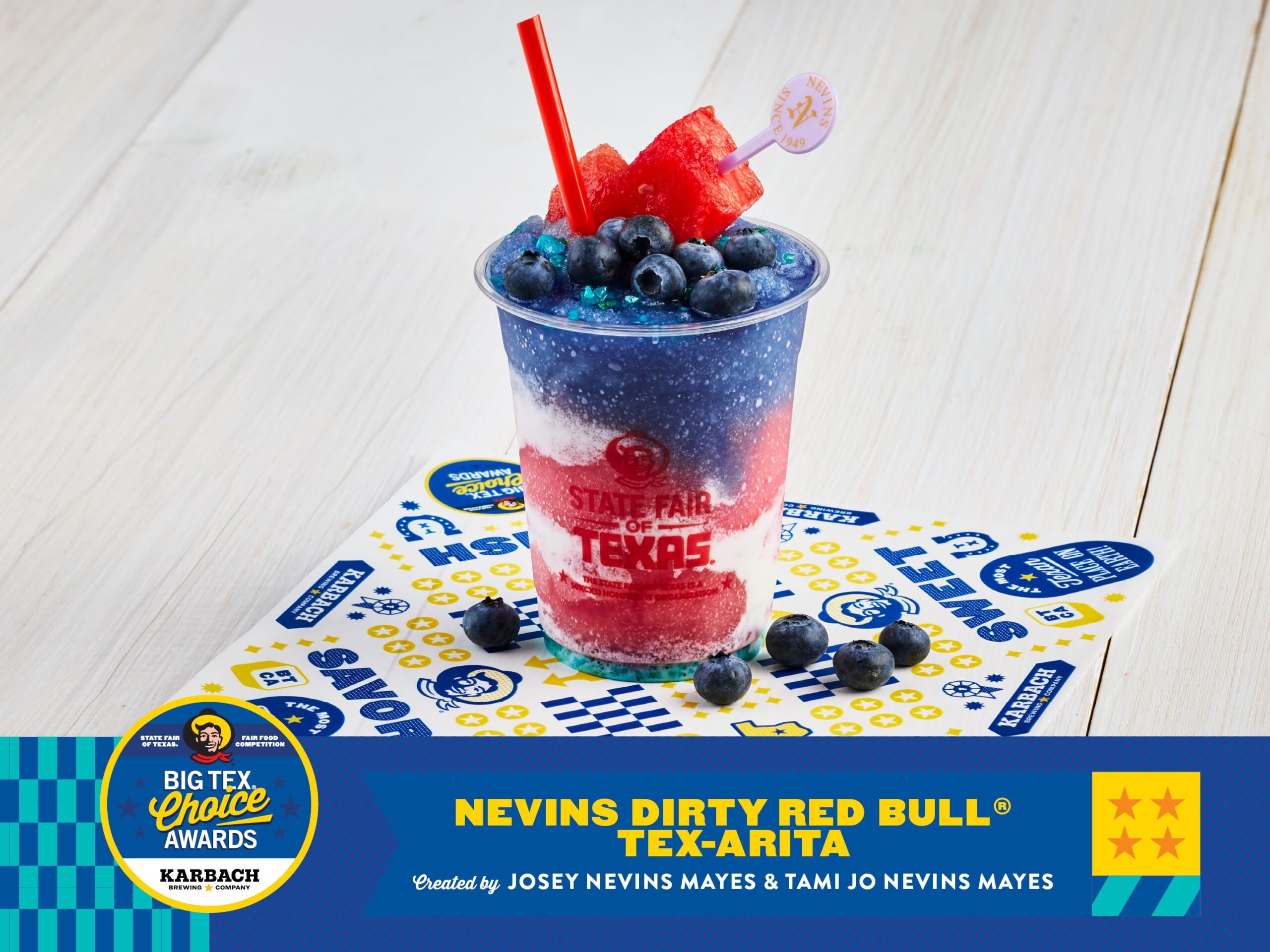
Red, white, blue – this afternoon delight is right on cue! A refreshing adult beverage that tastes as good as it looks! The Nevins Dirty Red Bull® Tex-arita fulfills an adult craving while appealing to your inner child! This cocktail starts with a layer of sweet cream liquor and Blue Razz Pop Rocks® to get this sweet treat poppin’! After, it’s filled halfway with juicy Watermelon Red Bull® margarita and the other half with vibrant Blueberry Red Bull® margarita. Topped with more sizzlin’ Pop Rocks®, fresh blueberries, and watermelon, this Dirty Tex-arita is sure to make you soar!
Poppin’ Boba Rita, Justin Martinez
This frozen, fresh lime juice margarita is elevated with wine-infused poppin’ boba pearls, bursting with juicy mango or strawberry flavor in every sip. Each vibrant pearl in the Poppin’ Boba Rita delivers a playful pop of tropical fruitiness, transforming the experience into a sensory delight. Want to turn up the indulgence? “Make it dirty” with a swirl of sweet, creamy, cold foam, a splash of rich coconut syrup, and a tangy Tajin® rim, making for an irresistible upgrade to this tapioca treat with a twist!
These 15 Fairly-foodie finalists will battle for the four titles on Thursday, August 21, at 2 p.m. CST. While the Big Tex Choice Awards event is closed to the public, folks can follow along online by tuning into one of our social media channels – @StateFairofTX on Instagram and Facebook.
The 2025 State Fair of Texas, themed “Texas Shines Bright,” will open on Friday, September 26, and will run through Sunday, October 19. Head on over to BigTex.com/Tickets to purchase your season passes and FLEX Tickets today and join us this fall at the Most Texan Place on Earth.

More Than 700 Lions Receiving Their Degrees This Weekend

August 6, 2025 – COMMERCE, TX, August 6, 2025— The newest crop of East Texas A&M University alums will graduate at commencement ceremonies held on August 9 and 10 at the university Field House—1804 Lee Street—in Commerce, Texas.
In total, 756 graduates will receive degrees in one of three ceremonies held over the weekend. Below are the stats on this year’s summer graduating class:

- Youngest graduate: Age 16
- Oldest graduate: Age 69
- 22 U.S. states represented
- Two countries represented
- 322 first-generation college students
- 30 international students
- 43% have earned academic distinction
Commencement ceremonies are scheduled for the following dates and times:
- Graduate School Ceremony (All master’s and doctoral students)
Friday, August 8, at 4:30 p.m. (Link to view ceremony live stream)
- Undergraduate Ceremony (College of Agricultural Sciences and Natural Resources, College of Business, College of Education and Human Services, College of Humanities, Social Sciences and Arts, and the College of Science and Engineering)
Saturday, August 9, at 8:30 a.m. (Link to view ceremony live stream)
- Undergraduate Ceremony (College of Innovation and Design)
Saturday, August 9, at 10:30 a.m. (Link to view ceremony live stream)
Reminders:
- All guests must have an admission ticket.
- A clear bag policy is in place, enforced at the door.
- ALLOWED: Clear plastic, vinyl, or PVC bags; small wallet-sized clutches; small medicine bags
- NOT ALLOWED: Clear bags that have buckles, hardware, or décor concealing the bag, backpacks, regular-size purses, large totes, diaper bags, or other similar items
For more details or information on summer graduation ceremonies, visit the graduation webpage.
SNAP Restrictions Coming Next Year to Texas
August 6, 2025 – Governor Greg Abbott has announced that Texas has received federal approval to implement new restrictions on the use of Supplemental Nutrition Assistance Program (SNAP) benefits. Beginning April 1, 2026, SNAP recipients will no longer be allowed to use their benefits to purchase sweetened drinks, candy, or beverages containing five grams or more of added sugar or artificial sweeteners. The goal of this change is to improve the overall health of Texans by encouraging healthier eating habits and ensuring that taxpayer dollars support nutritious food choices.
The Texas Health and Human Services Commission (HHSC) will oversee the implementation of the waiver and work with retailers to ensure proper enforcement. The program will continue to allow purchases of essential and nutritious foods such as fruits, vegetables, meat, dairy products, cereals, and even seeds and plants for home gardening.
Governor Abbott emphasized that the new guidelines are aimed at promoting better health outcomes and reducing preventable diet-related illnesses. The waiver, approved by the Trump administration, is part of a broader effort to strengthen families and communities by improving access to healthy food options.
SNAP currently supports approximately 3.5 million Texans, and these changes represent a significant shift in how benefits can be used going forward.