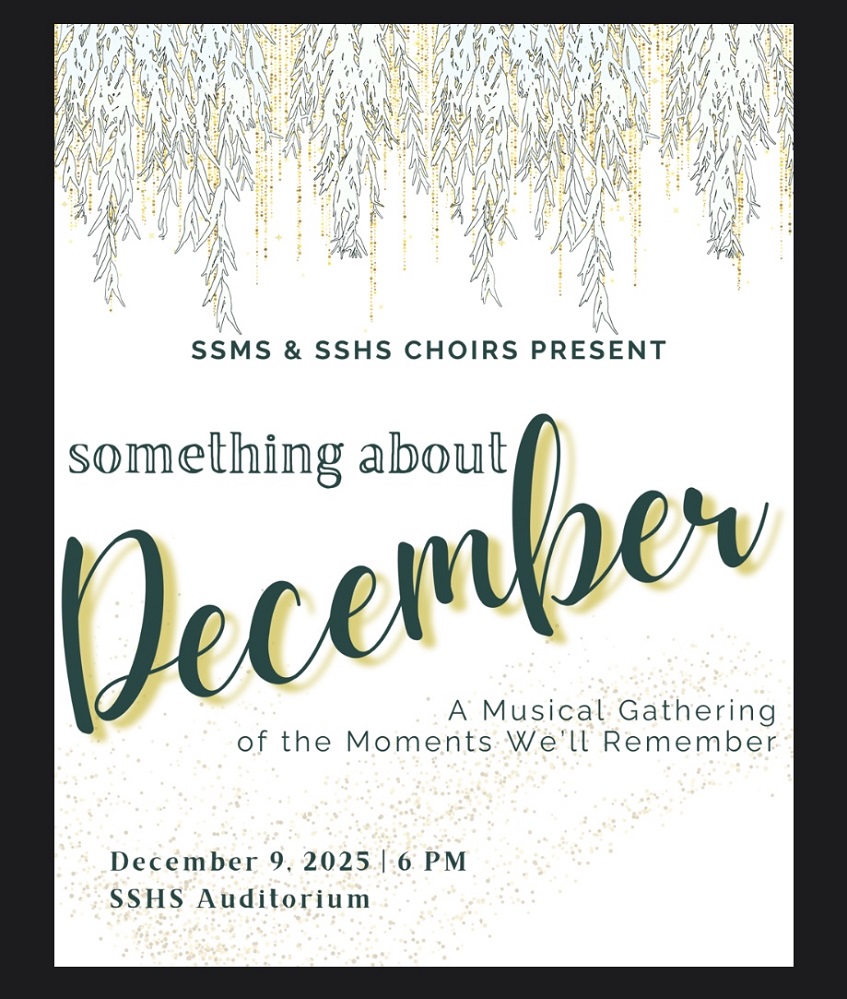
Learn About the SSHS Choir’s Christmas Concert Coming up December 9th on This KSST’s A Second Cup Of Coffee With John Mark Dempsey

November 28, 2025 – On November 18th, 2025, Sulphur Springs High School Choir Director, Beth Cole, dropped by for A Second Cup Of Coffee With John Mark Dempsey to chat about the SSHS Choir’s upcoming Christmas Program being held at the Sulphur Springs High School Auditorium on December 9th, 2025. Beth and John Mark also talked about Sulphur Springs’s Choir students, the All State Competition coming up on January 10, 2026, and much more. Be sure to check out this charming segment of KSST’s A Second Cup Of Coffee With John Mark Dempsey and learn about the Sulphur Springs High School’s Choir Director and what she has in store for her students.
Sherry Kay Sinclair

March 14, 1964 ~ November 27, 2025 (age 61)
Sherry Kay Sinclair, of Sulphur Springs, passed away peacefully, the morning of November 27, 2025 to be with her Lord. She was surrounded by her family until the very end. She was born on March 14, 1964 in Hope, Arkansas. Sherry had 30 years in education, starting her career in 1992 in Queen City, Texas. She then worked in Mt. Pleasant in 1997 and 1998, then moved to Sulphur Springs ISD, spending the last few years as Principal and Head Start Director at Douglass ECLC.
Sherry was a dedicated educator who loved her students and staff. Her dedication to her family was limitless. She brought joy and sunshine to a sometimes-dark world. She will be greatly missed.
She was preceded in death by her father, Jerry Don Bailey, Sr. and her brother Jerry Don Bailey, Jr. Sherry is survived by her husband of 37 years, Shawn Sinclair; son, Sawyer Sinclair; daughter, Skyler Sinclair; sister, Marla McCord; and her in-laws, Bill and Tommie Sinclair; and numerous nieces and nephews.
Services will be held at 2:00 PM on Tuesday, December 2, 2025 at the Hopkins County Regional Civic Center, 1200 Houston St, Sulphur Springs, TX 75482. Interment will follow in Forest Lawn Cemetery in Mt. Pleasant, Texas.
Arrangements are under the direction of West Oaks Funeral Home. www.westoaksfuneralhome.com

MISTLETOE By Master Gardener Ronnie Wilson

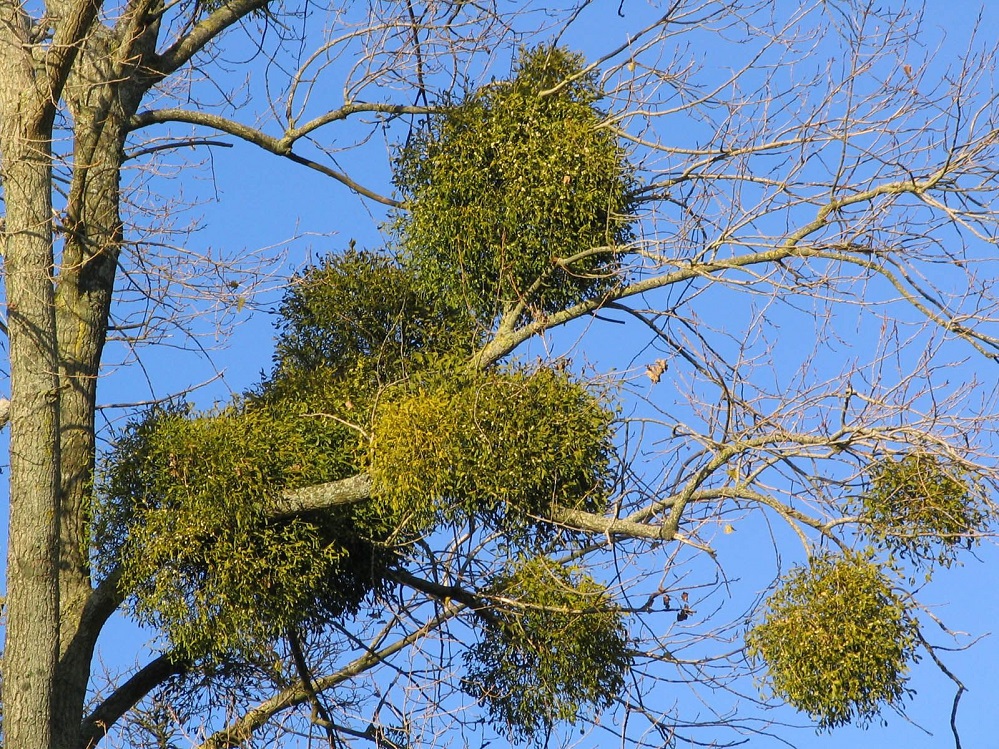
November 28, 2025 – Mistletoe has long been associated with the Christmas holidays, and the idea of kissing under the mistletoe is a favorite of many people, both young and old. Mistletoe has historically represented romance, vitality, and fertility. The ancient Greeks’ winter holiday Kronia used mistletoe as part of the celebrations, and the tradition of “kissing under the mistletoe” may have started there. How this idea started (and continues!), is a mystery, since mistletoe’s life cycle and history seems a bit less than romantic…….
Mistletoe is a parasitic plant that takes water and nutrients from the host plant. The name comes from 2 Anglo-Saxon words—“mistel”, meaning “dung”, and “tan”, meaning “twig”. This combination of words refers to the plant spreading its seeds by bird or squirrel droppings. The scientific genus of mistletoe is Phoradendron, meaning “thief of the tree”.
Generally, mistletoe does not harm healthy trees, but is more often found on older, declining, and sparsely leafed trees. Strong trees have a dense canopy that helps shade mistletoe out and preventing it from taking hold, while the bark of a vigorous tree can grow more quickly than the roots of the mistletoe, preventing them from reaching the tree’s nutrients.
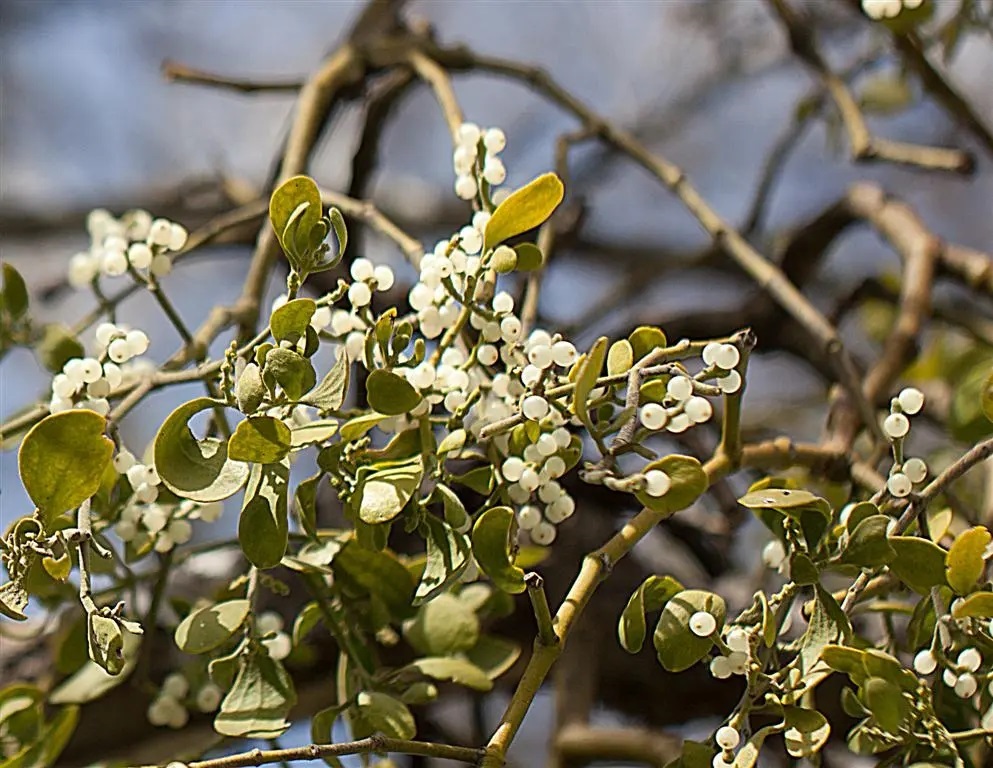
Mistletoe is evergreen and keeps its leaves year round, and is more easily seen in fall and winter when the host tree loses its leaves. Mistletoe produces its greenish-white berries from October to December. These berries are quite sticky, and attach themselves to the bark of the host tree until conditions are right for germination. After germinating, the seeds send roots into and through the bark, seeking nutrients in the tree branch.
The berries are poisonous, and should be kept away from children and pets. Wash hands with soap after handling the plant. If taken indoors, keep mistletoe away from heat, as it will dry out and become a fire hazard.
Control of mistletoe is difficult. Removing entire limbs infested with mistletoe can be more harmful than useful to the tree. Removing the clumps is a stopgap remedy, as the mistletoe will re-grow, but it does remove a source of future seeds. It can be treated/sprayed with a plant growth regulator, but this procedure should be done by a licensed pest control operator. This may involve a high cost, especially for an older, weak tree.
A parasite with poison berries, spread by animal dung! Makes one feel romantic, doesn’t it??

POINSETTIAS By Master Gardener Ronnie Wilson

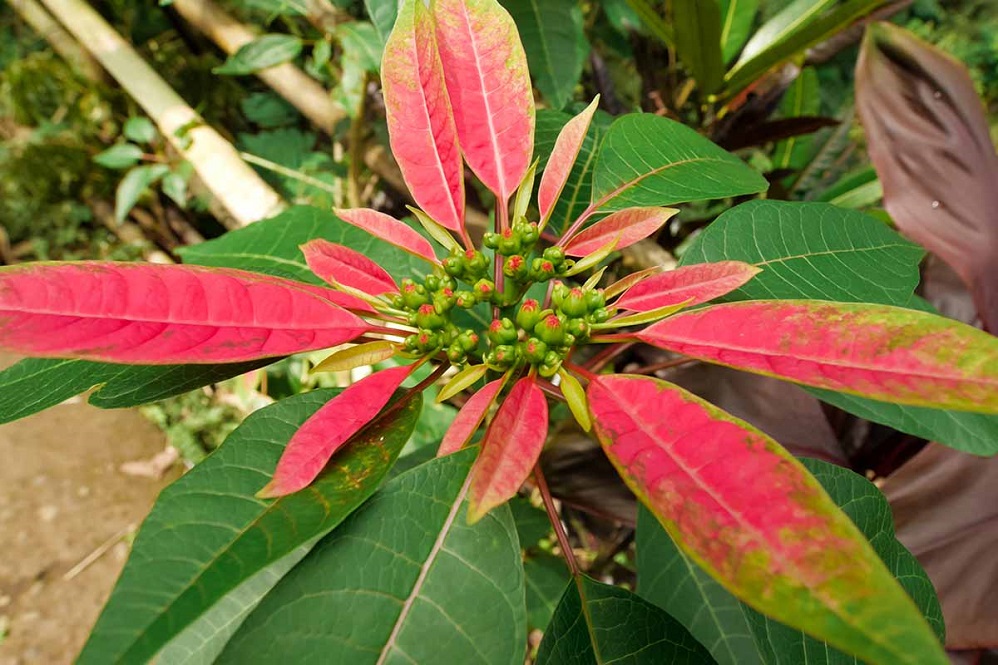
November 28, 2025 – Poinsettias are everywhere! Nurseries, garden centers, even grocery stores are now selling these plants for Christmas color and decorations. These plants are famous for their bright red foliage, and make a great Christmas display of holiday cheer. Although we are used to seeing poinsettias as red plants, they come in many varieties and colors. The “leaves” are actually called “bracts”, and the “flower” is a small cluster in the center of the plant.
Poinsettias are native to Mexico and Central America, and are perennial plants in Zones 9-11. Unfortunately for Hopkins County, we are a Zone 7 area, and poinsettias will not survive our winters outside, but can be grown indoors.
Anyone who wants to keep their Christmas poinsettia alive through the winter can place the plant in a window that gets bright, indirect sunlight, avoid drafty areas, and keep the temperature constant around 65-75 degrees. Do not feed poinsettias while blooming. After the blooming period, poinsettias need a little liquid all-purpose fertilizer monthly, applied at about ½ the recommended rate. Water lightly when the top of the soil is dry, and try to keep the soil moist, but not wet.
Be aware that the sticky, white sap from the plant can cause skin irritations and rash. Wash hands well after handling the plant.
To get poinsettia bracts (leaves) to change color is not a quick process! The bracts naturally change color when the days become shorter and the plant receives less sunlight. To simulate nature and “trick” the plant, at the end of September begin to put the plant in total darkness for 16 hours everyday, with the remaining 8 hours in a bright, sunny window. Then at Thanksgiving, stop the total darkness treatment, and put the plant in a window with indirect sunlight. Soon, the bracts will change color in time for Christmas!




FedEx Fowl-Up Causes Smoked Turkey Delivery Delays

November 27, 2025 – TYLER, Texas — A Thanksgiving scramble is underway after a major Texas turkey supplier said hundreds of its holiday orders may not be delivered in time. Greenberg Smoked Turkey, Inc., a longtime family-run business in Tyler, reported that turkeys bound for North Texas customers became stuck inside a FedEx distribution facility in Hutchins.
The delay, which the company says is outside its control, has left both the supplier and customers frustrated during one of the busiest food-shipping weeks of the year. Greenberg officials said they were notified that dozens of pallets of boxed turkeys were sitting idle in the Hutchins hub, with little clarity from FedEx on when they would move again.
For many families, Greenberg’s smoked turkeys are a traditional centerpiece, and the potential disruption comes at the worst possible moment. “We know how important these turkeys are to your holiday,” the company said in a statement, adding that it is working around the clock to monitor shipments, provide updates, and offer refunds where necessary.
FedEx has not publicly commented on the cause of the bottleneck, though staffing shortages and high holiday package volume have strained carriers nationwide.
Greenberg Smoked Turkey urged customers awaiting deliveries to check tracking numbers frequently. The company said it remains hopeful that most shipments will still arrive before Thanksgiving—but acknowledged that some may not make it in time for Thursday’s holiday meals.

That $100 Million For Childcare in Texas Didn’t Go Far

November 27, 2025 – LUFKIN — When Texas lawmakers approved a $100 million boost to the state’s child care scholarship fund earlier this year, the investment was billed as a lifeline for working families struggling with soaring child-care costs. But months later, many child-care centers say they have seen little change — and thousands of eligible families remain stuck on waitlists.
The problem, state officials and providers say, comes down to how the money was structured and how quickly costs have risen.
The $100 million infusion was intended to stabilize the Texas Workforce Commission’s child-care assistance program, which helps low-income parents afford care so they can stay in the workforce. But unlike past emergency federal funding, the new state money did not expand capacity. Instead, it was largely absorbed by rising reimbursement rates — the amount the state pays providers per child.
In short: the money helped keep the system from collapsing, but it didn’t create many new spots.
Providers across East Texas say they’re operating at — or beyond — capacity, with staffing shortages making expansion nearly impossible. “We can’t open a new classroom without a qualified teacher,” said one Lufkin-area director. “Even if more families qualify for aid, we have nowhere to put the kids.”
Families are feeling the impact. While demand for subsidized child care is growing, especially in rural and low-income areas, providers say inflation, rising wages, and new safety and quality requirements have outpaced funding. As a result, the $100 million stabilized the program on paper but failed to meaningfully shorten waitlists.
Child-care advocates argue that Texas will need recurring, long-term investments — not one-time boosts — to make subsidized care both accessible to families and financially sustainable for providers.
For now, parents in Lufkin and across the state continue waiting, hoping the next legislative session delivers a fix.

Texas Wants Drastic Fee Increase For Camps After Tragedy

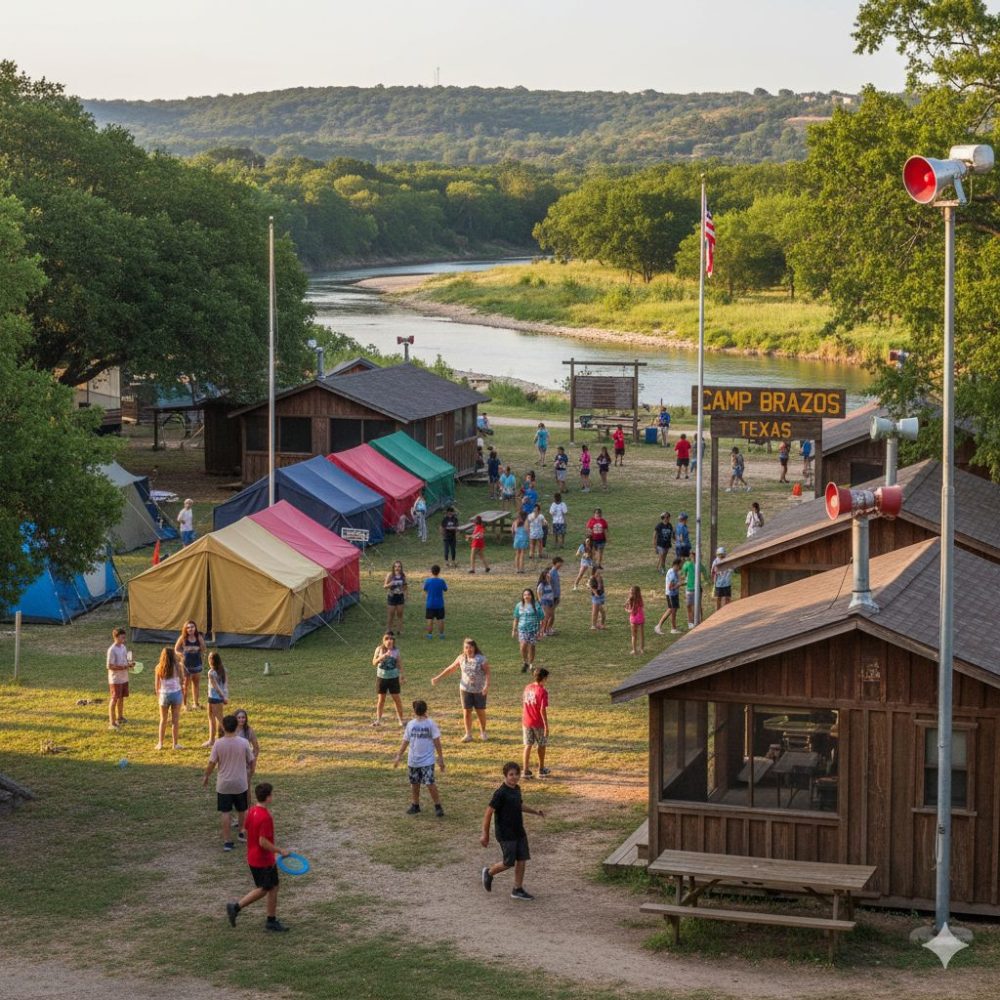
November 27, 2025 – Texas regulators have proposed dramatic hikes to summer camp licensing fees — increases that could reach as much as 4,000% — sparking concern among camp operators that many longtime youth and overnight camps might be forced to shut down.
Under current law, the initial license fee for a residential youth camp — like an overnight summer camp — is $750, with annual renewals ranging from $103 to $464 depending on the camp’s size.
Under the new proposal filed by the Texas Department of State Health Services (DSHS), that initial fee would soar to as high as $21,000 for very large camps, while renewal fees for some camps could rise to as much as $19,500 per year.
Day-camp fees would also climb steeply: from $250 to as high as $3,200, based on camper volume.
State officials argue that the increase is needed to help fund expanded oversight, inspections, and enhanced safety regulations passed in response to the tragic July 4 floods at Camp Mystic and other camps.
But critics — including many small, nonprofit camps — warn that the cost jump is untenable. Some say they may not survive the added financial burden.
Camp directors told DSHS they support increased safety, but pleaded for more reasonable fee structures. “This causes an undue burden for smaller or more remote camps,” one operator wrote.
Others said that the new broadband-connectivity and evacuation-plan requirements, in addition to skyrocketing fees, could force them out of business.
The proposals also include a restructuring of the state’s Youth Camp Advisory Committee — reducing representation from camp operators and adding seats reserved for child-safety experts, parents, and mental-health professionals.
The public comment period on the rules is open through mid-December. As Texas camps weigh their future, many worry that some of the state’s oldest summer traditions may vanish.
USDA Attempts to Stabilize US Fruit Market

November 26, 2025 – Texas hopes that the U.S. Department of Agriculture puts Texas-grown fruit at the forefront of a new federal food-supply initiative. This follows the USDA’s announcement that it will purchase up to $30 million in fresh fruit from American farmers.
The USDA purchase is part of a broader effort to stabilize the national food supply chain, support domestic growers, and respond to recent market disruptions caused by weather events, trade pressures, and agricultural import imbalances. Federal officials say the fruit will be distributed through nutrition programs and food banks, helping address ongoing food-insecurity challenges across the country.
Texas Agriculture Commissioner Sid Miller welcomed the investment but said Texas producers must play a central role. He argued that Texas citrus growers — especially those in the Rio Grande Valley — have been hit harder than most states due to repeated freezes, drought, and what he described as Mexico’s failure to meet its water-delivery obligations under the 1944 treaty governing Rio Grande flows.
“Texas farmers aren’t looking for a handout, just a level playing field,” Miller said, calling Texas fruit “the sweetest, freshest citrus in America.”
Texas remains one of the nation’s top citrus producers, with oranges and grapefruit serving as economic pillars for South Texas communities. Miller said USDA’s purchase program can only reach its full potential if Texas fruit is represented in federal contracts.
The commissioner also praised President Trump and Agriculture Secretary Rollins for prioritizing American-grown products, calling the $30 million commitment a meaningful step toward strengthening the domestic agriculture sector amid a volatile global market.
The USDA is expected to begin issuing contracts in the coming months.

Paxton Warns About College Sports Commission Power Grab

November 26, 2025 – Attorney General Ken Paxton is escalating his fight with the College Sports Commission (CSC), sending formal letters to Texas universities — and to attorneys general across the country — urging them to reject what he calls an “unlawful” and “dangerous” agreement that would reshape control over college athletics.
Paxton’s warning targets the CSC’s proposed University Participation Agreement, a document that would govern member schools across major athletic conferences, including the ACC, Big 12, SEC, and Big Ten. The CSC, a newly formed national governing body created in response to ongoing legal battles around NIL compensation and athlete employment status, is seeking broad authority over compliance, finances, and future policy decisions.
Paxton argues the agreement would give the CSC “practically limitless power” while stripping universities of autonomy. Among the most controversial provisions, the agreement would penalize any school that cooperates with its own state attorney general in legal challenges against the CSC — even making universities ineligible for postseason play if they provide information, documents, or testimony in such cases.
The Attorney General also warns that the agreement allows the CSC to impose arbitrary fines, sanctions, and new policies without meaningful oversight or an appeals process. He says the arrangement could expose universities to significant legal risk and may violate the Texas Constitution, potentially making it illegal for state-funded schools to sign.
In letters sent to universities in Texas and to AGs nationwide, Paxton urged officials to intervene and advise schools in their states to reject the agreement. His office argues that the CSC is attempting to shield itself from lawsuits while consolidating unprecedented control over college sports governance.
Paxton framed the issue as a matter of protecting both taxpayer-funded institutions and the integrity of college athletics.
“This power grab by the CSC must be stopped,” he wrote. “No entity should be allowed to give itself this level of immunity at the expense of our universities.”
The dispute sets up a growing national showdown over who should govern the rapidly changing landscape of college sports.

Learn About Teacher Lewis Ben Smith’s Book Signing Event November 29th on This Segment of KSST’s A Second Cup Of Coffee With John Mark Dempsey

November 25, 2025 – Local author Sharon Feldt had A Second Cup Of Coffee With John Mark Dempsey to talk about the book signing for Sulphur Springs History Teacher Lewis Ben Smith being held November 29th, 2025. Sharon and John Mark also chatted about the book, Firestorm, the book, The Emperor Of Gladness, and much more. Learn about what’s going on at a local small business and perhaps learn about a new book you’ll want to read on this charming episode of A Second Cup Of Coffee.