Dinner Bell for October 30, 2024
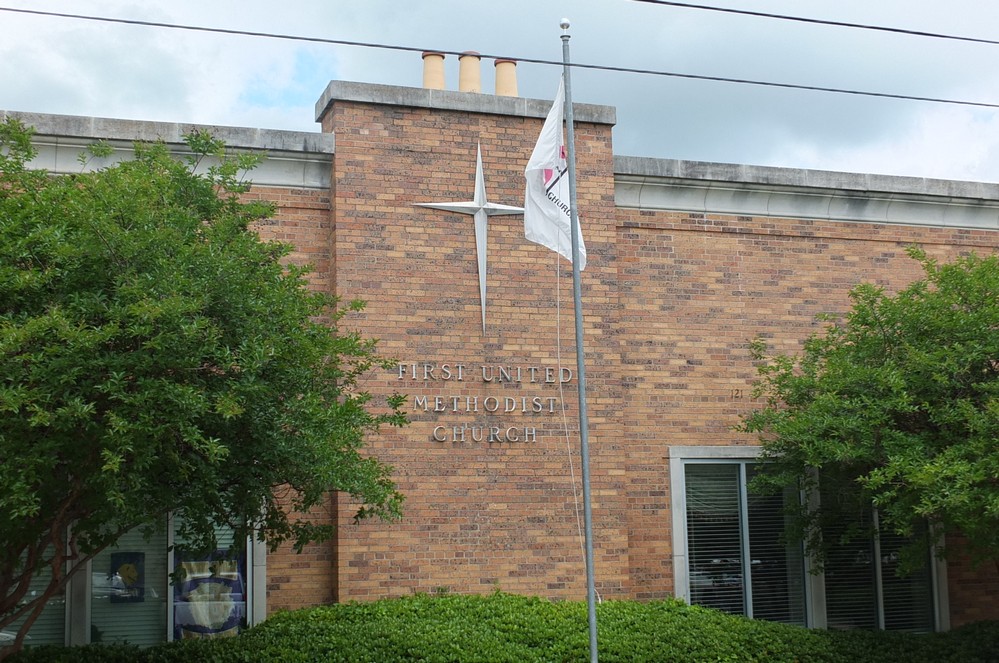
The doors to Fellowship Hall at First United Methodist Church will open at 11:00 a.m. Meal service begins at 11:30 a.m. and doors will close at 12:45 p.m. Please come join us to share fellowship and a meal.
Alliance Bank was chartered as Sulphur Springs State Bank on June 13, 1927. The bank turned a profit that year and has done so every year since then, 97 continual years! The bank building at Main and Gilmer was destroyed by fire in 1934, causing the Bank to move to its present location on the North side of the square.
In 1937, the Carnation Milk Plant opened and began buying Grade A Milk. The bank arranged attractive loans to cotton farmers to purchase dairy cows to sell milk to the plant. This started a relationship between the Bank and the Dairy Industry that continued for many years.
Sulphur Springs State Bank began serving Greenville and Hunt County in July 1990. With moving East, West and into the Metroplex, the Bank officially changed its name to Alliance Bank in October, 1996. In addition to banking Alliance Bank owns and operates Galyean Insurance Agency and a brokerage company, Alliance Financial Services. Innovative banking products that meet the varied needs of the communities it serves has kept its customers and added new ones to a bank with local people they can trust.
The Dinner Bell Feeding Ministry began its association with Alliance Bank on March 1, 2017, which continues today with four appearances yearly. For this relationship, the Dinner Bell is extremely thankful.
The Dinner Bell Feeding Ministry has been blessed with a Partnership with City National Bank since June 8, 2016. For a number of years the bank has supplied financial support and personnel to serve meals on a quarterly basis. We plan to continue inside dining every Wednesday with the exception of the Wednesday before Thanksgiving, Christ mas and New Years Day.
MENU:
Chicken Hashbrown Casserole
Arkansas Green Beans
Garden Salad
Buttered Bread Slices
Apple Crisp
Take care of YOURSELF by following safe health practices as flu and COVID are lurking in our midst! Wear masks where required! Wash your hands often! Get inoculated and boosted
DINNER BELL CARES ABOUT YOUR HEALTH !!!
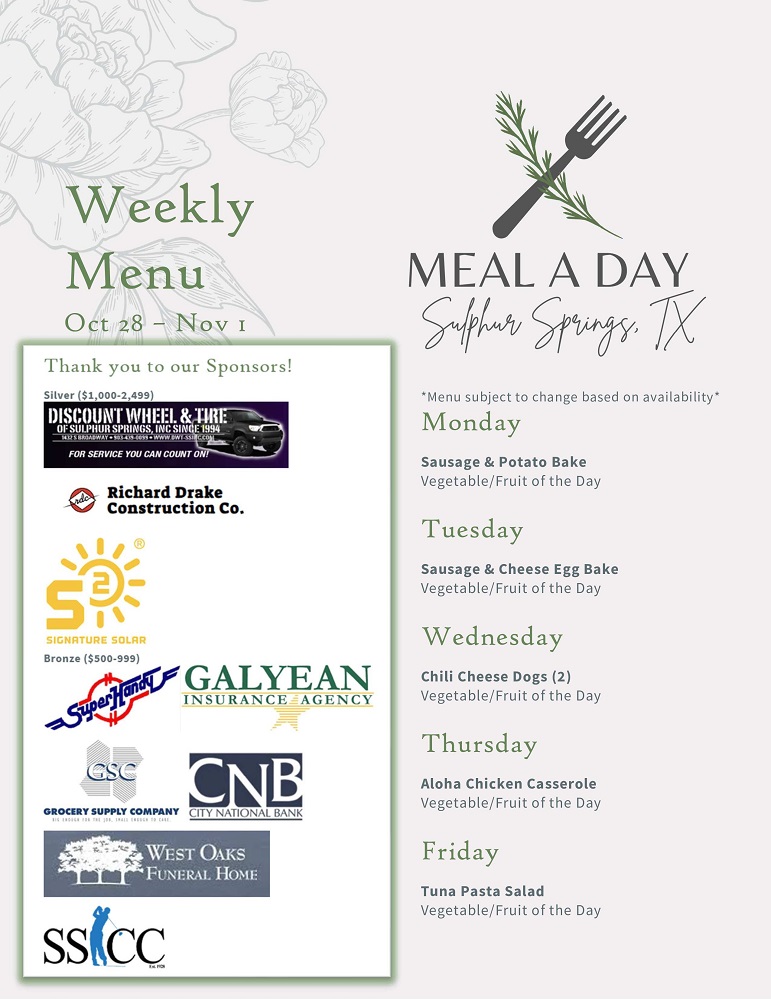
Meal-A-Day Menu for Oct. 28 Through Nov 1, 2024
Here is the menu for Meal-A-Day for October 28th through November 1st 2024.
Delta County Enacts Burn Ban This Week
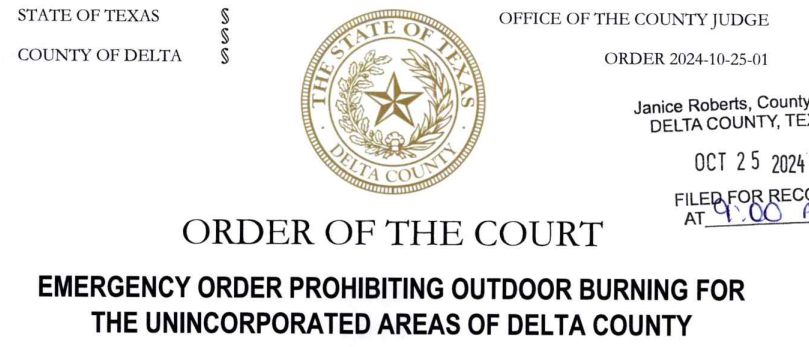
October 25, 2024 – As of October 25, 2024, Delta County, Texas is under an outdoor burning ban in unincorporated areas.
This order follows an expired 90 day burn ban set in August. According to the current ban, it will be in effect for 7 days. A reevaluation will conducted after the initial period.
A copy of the full order is available here.
Texas Oyster Season Opens November 1
October 25, 2024 – AUSTIN— Storms and flooding that hurt oyster production on Texas coasts will lead to a limited opening of commercial and recreational public oyster harvest areas during the upcoming season, Nov. 1-April 30.
Due to sampling surveys that identified oyster reefs with low abundances of market-sized oysters, Texas Parks and Wildlife Department (TPWD) will open 10 of 28 shellfish harvest areas to fishing at the beginning of this season.
“Oysters form an important habitat that provides many ecosystem services as well as a fisheries resources, and the Texas Parks and Wildlife Department (TPWD) is working hard to balance the protection and restoration of wild oysters with the needs of the commercial oyster industry,” said TPWD Executive Director David Yoskowitz, Ph.D. “The department is increasing restoration efforts, closely monitoring reefs and taking prompt action if overfishing occurs and streamlining programs, like cultivated oyster mariculture. For this year, our sampling data shows that wild oysters are still at low abundances and struggling.”
Prior to the start of the season, TPWD conducted targeted sampling in each oyster area to assess the abundance of market-sized oysters. The areas that met the opening threshold abundance are set to open for the upcoming oyster harvest season on Nov. 1.
TPWD also considered the need to distribute commercial oyster fleets over larger geographical areas to prevent over harvest. To accomplish this in the 2024-2025 season, the department will open three additional harvest areas that contain reefs with relatively high abundance of market-sized oysters, along with reefs of lower abundance. These areas do not meet the traditional abundance metrics to open, but because there are reefs with enough market-sized oysters to support harvest and a need to distribute the fleet across a broader geographical area, the department has opened these areas and will monitor them closely for signs of over harvest. The remaining shellfish harvest areas that do not meet previously stated metrics of market-sized oyster populations will be closed at the start of the season and be closely monitored in-season, should they meet the threshold for opening.
Galveston Bay has historically been a large source of commercial oyster harvest. However, oyster populations in Galveston Bay currently present low oyster abundance, as reflected in TPWD’s sampling data.
“We had hoped for better oyster abundance numbers that would’ve allowed for more areas to be open this season,” said Robin Riechers, director of TPWD’s Coastal Fisheries Division. “Unfortunately, tropical storm Alberto and Hurricane Beryl caused high amounts of freshwater inflow into the Galveston Bay system, which resulted in considerable oyster mortality in Texas’ bays. We will continue to pursue oyster restoration efforts to hopefully allow our wild oyster population abundances the chance to increase in both for commercial purposes as well as for the numerous ecological benefits oysters provide.”
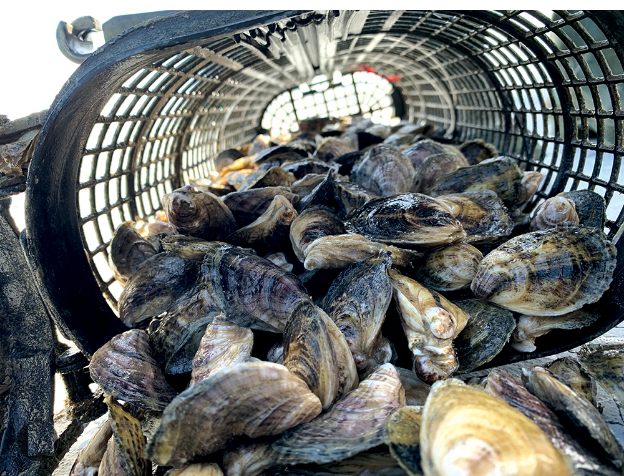
Oysters benefit the environment in various ways, including:
- Providing essential habitat for fish and invertebrates
- Protecting against erosion by buffering wave action and storm surge
- Enhancing water quality by serving as a filter for water in the bays
Closing areas to harvest helps preserve and replenish these ecosystem services. To facilitate reef recovery, TPWD will continue to sample open shellfish harvest areas and close zones that drop below recommended metrics.
A map showing the shellfish harvest areas can be found on the Department of State Health Services (DSHS) website. The list below does not reflect harvest area closures for public health. Please visit the DSHS website for the latest information.
Texas Parks and Wildlife code allows for the emergency closure of reefs to oyster harvest when evidence shows they are being overworked. These closings are based on samples collected by TPWD showing low catch rates of legal-sized, harvestable oysters.
Of the 28 shellfish harvest areas along the Texas coast, 10 will be open at the start of the public oyster season.
The following shellfish harvesting areas will be open to public harvest beginning Nov. 1:
Galveston Bay
TX- 2
TX- 4
TX- 8
Matagorda Bay
TX- 19
TX- 20
San Antonio Bay
TX- 26
Aransas Bay
TX- 29
TX- 30
Corpus Christi Bay
TX- 33
Laguna Madre Bay
TX- 34
Note that TX areas 2, 4, 8, 33, and 34 were not sampled as these areas typically have minimal to no harvest. By default, all TX areas not sampled prior to the season will open Nov. 1.
The following shellfish harvesting areas will be closed to public harvest beginning Nov. 1:
Galveston Bay
TX- 1
TX- 3
TX- 5
TX- 6
TX- 7
TX — 9
Matagorda Bay
TX-11
TX- 12
TX- 14
TX- 15
TX- 16
TX- 18
TX- 21
San Antonio Bay
TX- 24
TX- 25
TX- 27
Aransas Bay
TX- 28 *Note TX-28 was closed by the TPW Commission Nov. 8, 2022
TX- 32
For All Souls’ Day, CBP’s Laredo Field Office Reminds Public of Prohibited Agricultural Items
October 25, 2024 – LAREDO, Texas — As the U.S.-Mexico border community observes the All Souls’ Day (Día de los Muertos) holiday, U.S. Customs and Border Protection officials representing Laredo Field Office ports of entry are advising the traveling public that certain agricultural items used in holiday decorations are prohibited from entry to the U.S. and can carry harmful pests and disease, such as the citrus greening disease. Also, CBP would like to remind the public of prohibited fruits that tend to be brought by travelers during this holiday period.
“As All Souls’ Day draws near, CBP agriculture specialists at South Texas ports of entry tend to see an increase in travelers bringing agricultural items from Mexico to decorate altares to honor their departed loved ones and want to remind them not to bring in prohibited citrus and floral arrangement fillers,” said Director, Field Operations Donald Kusser, Laredo Field Office. “Our CBP agriculture specialists conduct agricultural examinations every day, and their work is critical in preventing plant pests and diseases not known to exist in the U.S. from establishing themselves and inflicting ecological and economic harm on American agriculture.”

During Allhallowtide season, which encompasses the three days of Halloween (Oct. 31) All Saints’ Day (Nov. 1) and All Souls’ Day (Día de los Muertos in Spanish) (Nov. 2) many border community families celebrate Día de los Muertos by constructing altares (altars) to commemorate the lives of loved ones that have passed on. A common type of ornamental greenery known as murraya or orange jasmine is often used in the construction of altares. Murraya is a host plant for the Asian citrus psyllid, Diaphorina citri Kuwayama, an insect that can carry citrus greening disease and is therefore prohibited from entry into the U.S.
Citrus greening, also known as “huanglongbing,” is a disease caused by a bacterium that can infect most citrus varieties and some ornamental plants (such as orange jasmine); this disease was first detected in the U.S. in 2005 in the state of Florida, Miami-Dade County. According to the U.S. Department of Agriculture (USDA), the disease has seriously affected citrus production in India, Asia, Southeast Asia, the Arabian Peninsula and Africa.
Citrus fruit that is prohibited from personal importation includes the following: oranges, grapefruit, tangerines, sour oranges and sweet limes. Other popular fruits that also are prohibited include guavas, mangoes, peaches and pomegranates.
Failure to declare prohibited agricultural items also can result in fines. Penalties for personal importations of undeclared, prohibited agricultural items, depending on the severity of the violation, can run as high as $500 and up to more than $250,000 for commercial importations.
The traveling public can learn more about bringing food items into the U.S. For more information regarding prohibited fruits, vegetables, prepared foods and other items, please consult CBP’s Know Before You Go guide.
Please also see detailed information about USDA guidelines for entering the U.S. while traveling with agricultural products from another country.
Attorney General Ken Paxton Takes Action After Biden-Harris Administration Selectively Targets Elon Musk’s Voter Registration Drives

October 25, 2024 – Attorney General Ken Paxton filed a Freedom of Information Act (“FOIA”) request with the U.S. Department of Justice (“DOJ”) to investigate the federal agency’s intimidation of businessman Elon Musk over his voter registration program that performs outreach to supporters of First and Second Amendment rights.

Musk’s super PAC has launched programs to encourage eligible American citizens to register to vote in various states. Reports surfaced that DOJ threatened Musk over the organization’s activities after Democrat politicians called the program “deeply concerning.” Attorney General Paxton filed a FOIA request for DOJ documents pertaining to actions against Musk and the super PAC.
At the same time, however, the Biden-Harris Administration has refused to cooperate with Attorney General Paxton’s efforts to ensure that noncitizens have not illegally registered to vote in Texas, and the Administration is openly hostile toward States with election integrity initiatives to prevent noncitizens from illegally voting.
On October 22, Attorney General Paxton sued the Administration for refusing to comply with federal law requiring them to assist States in verifying the citizenship status of potentially ineligible people registered to vote.
“The Biden-Harris Administration has egregiously weaponized the justice system against political opponents for the past four years,” said Attorney General Paxton. “Now, DOJ is selectively targeting Elon Musk’s voter registration drive while actively undermining States’ efforts to secure elections against noncitizen voters and potential fraud. At every turn, the federal government has become adversarial to States as we work to protect fair elections and the rule of law in this country.”
Learn how to Deal With Feral Hogs on this Episode of A Second Cup Of Coffee

On this episode of KSST’s A Second Cup Of Coffee With John Mark Dempsey, John Mark sat down with Texas A&M AgriLife Extension Hopkins County Agent Mario Villarino-Gutierrez. The two chatted about the current drought, how to deal with Feral Hogs, the current status of hay, and much more. Check out this episode of A Second Cup Of Coffee below and see what you learn.

Hopkins County United Way Sent a Pledge Update

October 24, 2024 – The Hopkins County Untied Way Campaign Workers held a pledge meeting October 22nd, 2024, at the Texas A&M AgriLife Extension Office in Sulphur Springs, Texas. Packages were turned in and totals were added up. Executive Security Susan Berning reports, “… Campaign pledges to date total $74,784.67! We will meet again this coming Tues., Oct. 29… ” Show your support and donate to the Hopkins County United Way. It’s for a great cause.

Texas A&M University-Commerce Honoring Those Who Served at 34th Annual Veterans Vigil

October 24, 2024 – This year’s annual installment features guest speaker U.S. Navy Chief Gunnersmate Vic Tornero (Ret.)
COMMERCE, TX, October 24, 2024—Texas A&M University-Commerce continues its tradition of honoring our nation’s veterans with the 34th installment of the Veterans Vigil, scheduled for Friday, November 8 at the Rayburn Student Center (RSC) on the university campus. The public is encouraged to attend.
Schedule of Events
The vigil will begin with a light breakfast reception at 10 a.m. before the opening ceremony begins in the RSC’s 2nd-floor conference rooms at 10:30. The A&M-Commerce Chorale will perform, and the Princeton High School Naval JROTC will provide color guard duties.
The ASTP Memorial Scholarship, which is given each year to an A&M-Commerce student veteran, will also be awarded during the opening ceremony. This year’s recipient is Melody Carmack, a U.S. Army veteran.
The opening ceremony will conclude outside of the RSC with the lighting of the vigil flame by Dr. Chris Myers, U.S. Air Force Lieutenant Colonel (Ret.) and A&M-Commerce professor of marketing and business analytics. The flame will burn until the closing ceremony at 4:30 p.m. that day. The closing ceremony will also feature a 21-gun salute by the Hunt County Veterans Honor Guard.
Vigil Guest Speaker
This year’s guest speaker is U.S. Navy Chief Gunnersmate Vic Tornero (Ret.). A native of El Paso, Texas, Tornero graduated from the University of Texas at El Paso, earning a bachelor’s degree in business administration with a minor in geology. Tornero proudly served two tours in Vietnam and was released from active duty in June 1968. After a break in service, he re-affiliated with the Naval Reserve program in September 1968. He drilled at the reserve center in El Paso until May 1980, when his civilian job transferred him to Fort Worth, Texas.
His assignments while in the Naval Reserve included Navy counselor, Navy instructor, reserve recruiter, petty officer indoctrination team leader and reserve retention officer. As a reserve retention officer, he conducted all-hands career information seminar briefings to more than 1,500 personnel at the Fort Worth NAS/JRB base theater.
Tornero’s unfailing team spirit led to his selection as the nation’s “Recruiting District Assistance Council Chairperson of the Year” in 1999. He credits this honor to his fellow RDAC members, who supported him during his tenure.
He has received numerous other awards, including the Navy and Marine Corps Commendation Medal (two awards), the Navy and Marine Corps Achievement Medal (two awards), the Vietnam Service Medal (two awards), the Republic of Vietnam Campaign Medal, and several other Navy service awards and ribbons.
Other Veterans Activities
Other activities surrounding the vigil include a free lunch for veterans at the A&M-Commerce Lions Mane Cafeteria the following Monday, November 11, with the presentation of a military ID, DD214, veteran’s card, or VFW or American Legion card.
In addition, from November 8 to 11, veterans will receive a 10% discount on all items at the University Bookstore.
Learn more about Veterans and Military Services at A&M-Commerce.

Mealybugs Inside Your Home From Master Gardener David Wall

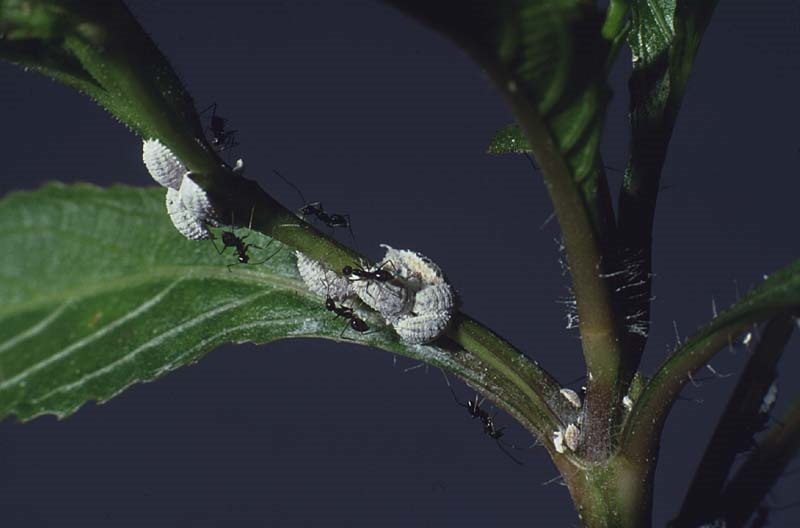
October 24, 2024 – Mealybugs (there are 4 varieties) are tiny scale insects resembling tiny puffs of cotton that suck sap from the flower and vegetable plant leaves and stems. In small invasions, they are hardly visible, cause no noticeable damage and can be removed by a strong stream of water, something not possible in larger infestations. As they multiply, however, the “cotton” appears to grow, with enlargement visible on a daily basis. They cannot fly, but plant crowding makes it easier for them to spread to other plants.
In larger numbers, they can overwhelm leaves causing them to die and drop, eventually killing the plant. They can occur anywhere on the plant, but are usually more noticeable on leaves. They can be particularly dangerous as you decide to move plants inside for the coming winter, an ideal environment for multiplying and destroying.
Mealybug prevention is best and can be achieved by having strong, healthy, resilient plants. Mealybugs like plants with a high nitrogen content and lots of new growth. Too much water and too much fertilizer make infestations worse. If you notice any white spots on plant stems or leaves, pick them off and squish them, or if indoors, drop in a waste basket.
The simplest way to kill mealybugs in your home is spraying the plants with a 50-50 mixture of water and alcohol in a spray bottle. Dusting infected plant with diatomaceous earth works very well, but you might want to take the plant outside first!
Horticultural oil sprays, insecticidal soap sprays, and homemade sprays will all kill mealybugs, but check with your county extension agent for mixture ratios. You can purchase ladybug beetles to feast on the mealybugs. Each beetle can consume up to 250 mealybugs during its lifetime. A Neem oil spray will repel but not kill them.