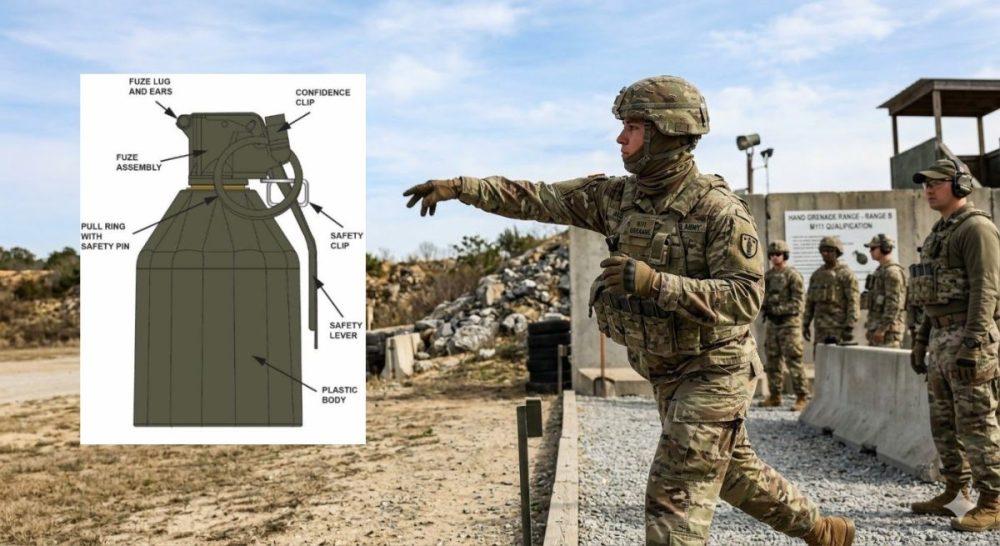
Army Approved New Grenade, the M111
March 18, 2026 – The United States Army has approved a new offensive hand grenade, marking the first time in nearly six decades that a new lethal grenade has reached full deployment status.
The earliest known hand grenades originated in Song Dynasty China (960–1279 AD) as “thunder crash bombs,” which were gunpowder packed into ceramic or metal containers with fuses. Earlier, 8th-century Byzantine forces used hand-thrown containers with Greek Fire, while 12th-century Persians used explosive-filled terracotta vessels.
Officials announced that the M111 Offensive Hand Grenade has been cleared for Full Material Release, allowing it to be fielded across Army units. The system was developed at Picatinny Arsenal in coordination with Army research and development teams.
The M111 is designed to replace the aging Mk3A2 grenade, which first entered service in 1968. The older model has faced increasing restrictions due to its asbestos-based construction. In contrast, the M111 uses a modern plastic body that is fully consumed during detonation, improving safety for soldiers.
Unlike traditional fragmentation grenades such as the M67, the M111 relies on blast overpressure to neutralize targets. This design makes it particularly effective in confined spaces like buildings and urban environments, where fragmentation can pose risks to nearby friendly forces.
Military officials say the new grenade reflects lessons learned from urban combat, including operations in Iraq, where fragmentation grenades were not always the safest option in close quarters.
The Army says the M111 will enhance both training and combat readiness by giving soldiers a safer and more adaptable tool. While fragmentation grenades will still be used in open environments, the M111 is expected to become the preferred option in enclosed and restricted terrain.