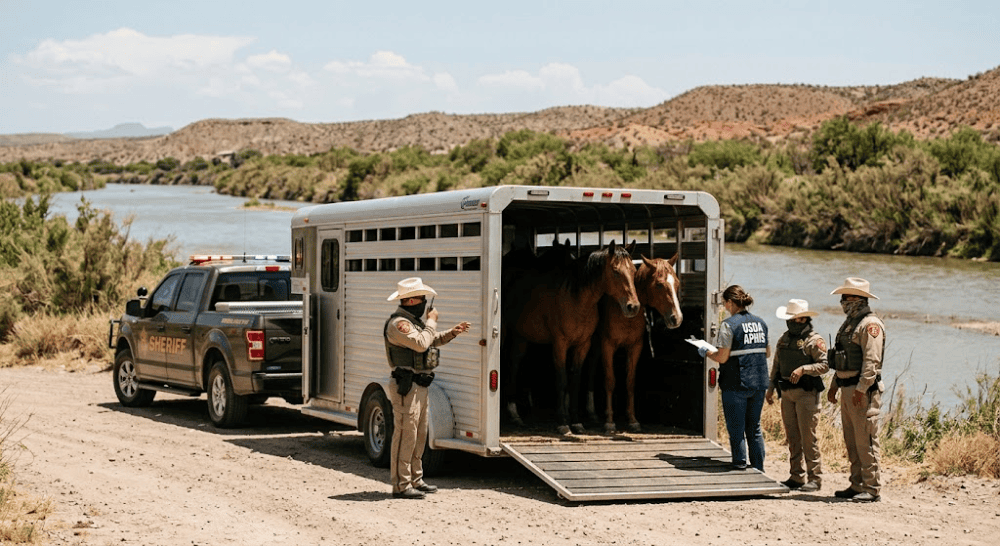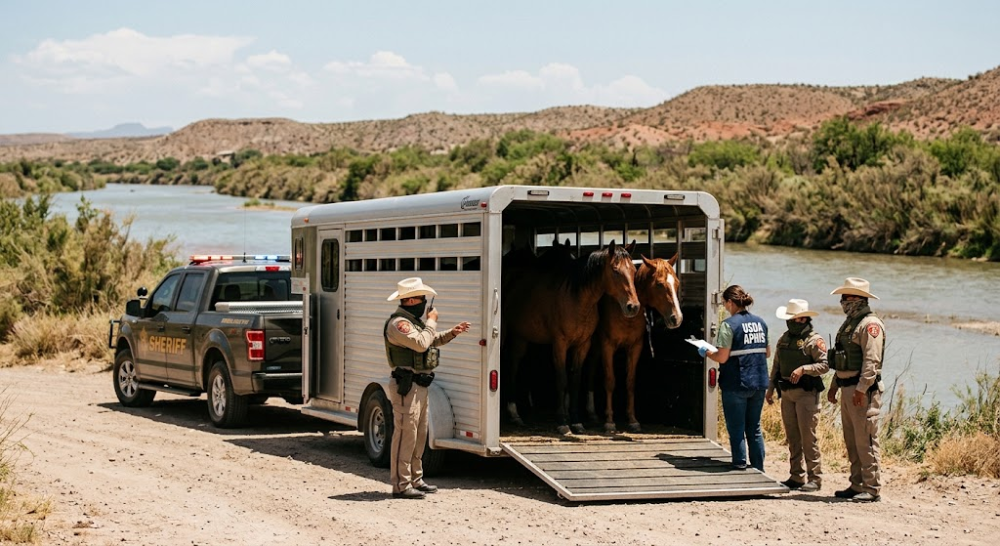
September 8, 2026 – REDFORD, Texas – When sheriff’s deputies intercepted a trailer hauling six horses near the tiny border town of Redford, Texas, the operation exposed a major gap in the nation’s biosecurity defenses. The animals had been walked directly across the Rio Grande from Mexico via a shadowy, cartel-linked smuggling network—completely bypassing the veterinary inspections, health certifications, and strict quarantine protocols required for livestock entering the United States.
Though the horses seized in late May were ultimately cleared of infection, the raid highlights a little-enforced vulnerability in the national response to a devastating threat: New World screwworm.
The flesh-eating parasite made its return to U.S. cattle in June despite aggressive federal containment measures, including a year-plus import ban on Mexican livestock, horseback inspection patrols, and the deployment of millions of sterile flies. However, while legal agricultural trade suffered billions of dollars in disruptions, an illicit animal trade continued largely unhindered through remote stretches of the southern border.
“These kinds of movements represent a risk because they allow the fly to travel much faster than it could move naturally,” warned Oscar Rico, a researcher at Universidad Nacional Autónoma de México who co-authored a predictive study on screwworm transmission dynamics.
High-Stakes Black Market Driven by Cartels
In remote Presidio County, Sergeant Deputy Sheriff Jaime Sanchez noted that trafficked horses can command $30,000 or more on the black market. By evading import taxes, paperwork, and mandatory veterinary screenings, smugglers undercut legal markets before transporting the animals to major hubs like Dallas and Houston for racing, farm labor, or charrería—Mexico’s traditional equestrian sport.
Over the past two years, Sanchez’s department has intercepted more than 50 smuggled horses. The corridor near Redford—historically known as “El Polvo” (the Dust)—has turned into a prime crossing zone. Controlled by La Línea, a cartel designated as a Foreign Terrorist Organization by the Trump administration in July, the isolated terrain offers vast cover.
“It’s easy for them to pay someone $500 or $1,000 per horse to cross it, load it onto the trailer, and drive off,” Sanchez said, pointing toward a shallow stretch of the river. “Since these are security matters, the issue of screwworm always comes up because it can hit economies very hard… In reality, we are very concerned.”
An Economic Nightmare for U.S. Agriculture
The stakes for American ranchers could not be higher. Before being declared eradicated in the U.S. in the 1960s, screwworm outbreaks killed thousands of livestock annually. In Texas, where the first new domestic cases were confirmed this year, experts estimate that a widespread outbreak could cost the state economy up to $1.8 billion.
The economic fallout is further complicated by rising meat prices. To bring relief to consumers navigating record-high beef prices, the Trump administration has partially reopened the border to Mexican livestock—even as Mexico’s animal health agency, Senasica, confirmed over 2,000 equine screwworm cases since 2024.
The smuggling pipeline extends far beyond horses. According to U.S. Department of Agriculture (USDA) officials and law enforcement, illicit movements involve:
- High-value rodeo & race horses
- Cattle slipping through unmonitored fence lines
- Dogs intended for illegal fighting rings
- Exotic wildlife, including primates, bears, and tigers
A National Security Priority
While federal authorities have not explicitly tied any of the country’s 48 confirmed screwworm cases directly to illegal trade, officials acknowledge that unmonitored crossings make full tracking nearly impossible. Epidemiologists emphasize that undocumented animals carry the exact same disease-transmission risks that officials previously attributed to illegal cattle movements from Central America.
USDA Inspector General John Walk underscored that the uptick in border trafficking has escalated from a regional agricultural issue into a national security crisis.
“It could be a vector,” Walk stated from his office in Washington, D.C., following a trip to Brownsville, Texas, to brief local police on the threat.
For generational cattlemen along the border, the return of the pest brings a grim sense of familiarity.
“It didn’t affect us for the last 50 years and lo and behold, here we are again with this thing upon us,” said 57-year-old rancher Ricardo Ramirez from his property in Zapata County, Texas.